Showing posts with label inspiration. Show all posts

Wednesday, December 19, 2012

5 Interesting Books by Thich Nhat Hanh

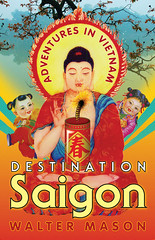
Thich Nhat Hanh is one of the most fascinating and compelling people alive - a real living spiritual treasure. I first came upon his work when I was a very young man, and I was delighted by the simplicty, clarity and lack of pretension in his message. I wanted to find out more about Buddhism, and he was the first writer to really bring it alive for me. It is because of Thich Nhat Hanh that I have spent the last 20 years exploring Buddhism and exploring Vietnam. It is no wonder, then, that my book Destination Saigon carries a thank-you note to him in the acknowledgements.
As well as being a meditation master and the second most famous Buddhist monk in the world (the Dalai Lama beats him), he is also a scholar and linguist, with a great love for literature and a real gift for expression. He has been a prolfic writer over the years, so I thought I would humbly present my own list of his books that have helped and inspired me over the years:


Savor - This is his newest book, and is co-authored with Dr. Lilian Cheung. It is a fascinating exercise - a kind combination Buddhist manual and diet book. Thich Nhat Hanh has always talked a lot about food in his writings: the need to eat mindfully, the need to be thankful for our meals, how to eat ethically etc. So I guess devoting a whole book to it is a natural progression. Interestingly, this is also the book that finally got him noticed by Oprah - so he at last carries the imprimatur of the queen of popular culture!


The Energy of Prayer - This little book is probably the one I turn to most. My copy is battered and dog-eared, filled with highlighting and comments. I have used it a lot in my meditation teaching, because I find it uses language that is quite familiar to Western, non-Buddhist minds. Master Nhat Hanh has been interested in the meeting of Eastern and Western spiritualities since he was a young man, and this book is the best melding of those traditions. Its final section is a series of prayers and meditations that would be helpful to anyone's spiritual life.
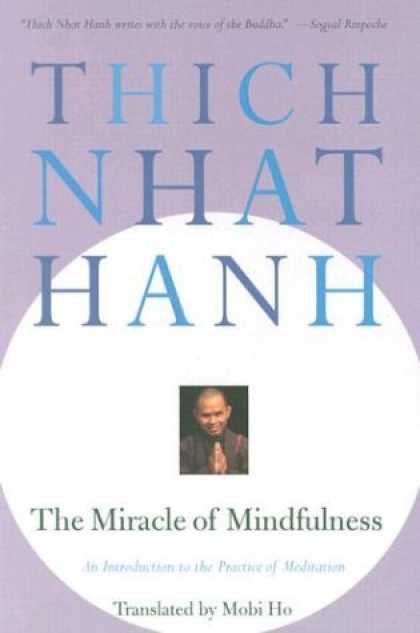


The Miracle of Mindfulness - Probably his best-known book, The Miracle of Mindfulness was something of a Bible for me in the 90s. I read it over and over as I traveled through Vietnam, Cambodia and Thailand, and my filthy copy was perused at some of the most beautiful and amazing locations! It is a beautifully written and belletristic exploration of meditation and mindfulness, and I promise it will be a constant inspiration.


Master Tang Hoi - One for the history buffs. Master Tang Hoi was the first Zen teacher in Vietnam, and this is the most intriguing book about him and his teachings. It is essential reading for anyone interested in Vietnamese history and culture, and for Zen enthusiasts it represents a meditation teaching that pre-dates Bodhidharma by 300 years!


Joyfully Together - If you are interested in building community and making the world a nicer place to be, this is a really wonderful place to start. It is one of Thich Nhat Hanh's more obscure titles, but I have found it to be tremendously useful and inspiring, and have drawn on its wisdom and advice many times. Master Nhat Hanh has himself established a global community of gigantic proportions, so why not learn from a master?

Saturday, January 29, 2011

Lunar New Year Fair, Cabramatta


I live in Cabramatta, which is the Vietnamese heart of Sydney.
Being alone for lunch, I made my way down to the town centre and checked out the New Year Fair which is going on there this weekend.


Lots of people, but stall-wise it was pretty much politicians and soy-sauce companies.


Still, everyone seemed to be enjoying themselves, and mercifully it's not as hot as it has been this week.


Thang was on the radio this morning talking about Tet and pointing out that this coming year is a double animal year - for Vietnamese it is the Cat, for Chinese the Rabbit.

Monday, June 28, 2010

Macau - Inspirations Along the Way #5


One of the pics I kept on the wall above my computer as I was writing Destination Saigon was of the ruins of St. Pauls in Macau.


It might seem an unlikely inspiration when writing a book about Vietnam, but Macau is one of my favourite places in the world, and whenever I think about it I become excited, literary and ever-so-romantic.


It is just one of those places. For centuries it's been a retreat for criminals, vagabonds, dissidents and every sort of neer-do-well. It has always played host to gangsters, pirates and every shade of underworld figure imaginable. It is, quite possibly, the most enchanting and fascinating island in the world, and I can never get enough of it.
I really hope to write a book about Macau one day, and I certainly plan on spending more time there in the coming years.
And no, I am not a gambler - I only ever set foot in the casinos to enjoy the outrageous buffets or admire the ultra-kitsch decors and architecture. But mostly I love the old Macau, the crowded, cobbled streets filled with churches, temples, restaurants and curio shops.


Just walking down a Macau street makes me happy, and makes me thankful that I live in such an incredible world filled with so much diversity and mystery.


It may take me a few years, but some day soon I am going to hole myself up in a little Macau hostelry and write the definitive book on the island.


Until then I will let my memories of the place inspire me in all of my creative efforts.

Sunday, June 27, 2010

Baron Corvo - Inspirations Along the Way #4


Having learned of my obsession, as a young man, with Gabriele d'Annunzio, my best friend at the time - an especially literary type - asked me casually if I was also a fan of Baron Corvo. I confessed that I had never heard of him, and she said "Oh, but you must read The Quest for Corvo - you will love it!" And so began my love affair with the wonderfully eccentric Baron Corvo and his crazy writings.
Of course, part of any love for Corvo normally rests with A. J. A. Symons' enthralling literary detective story The Quest for Corvo. I don't think there has ever been another book like it, and I think it is essential reading for all wannabe writers. Symons documents a literary obsession in a way that is hilarious, compelling and quite unique. In some ways he's a better author than Corvo ever was, but he only wrote one book of substance (this one), and it is so entirely convincing that most readers transfer their affection entirely to the book's subject, Baron Corvo.
Corvo was a distinctly mad English Catholic, a disgraced priest who lived a singularly destructive lifestyle that described an almost perfect downward spiral. He died penniless and half-starved in Venice, where he lived on the streets and earned his living as a procurer of young men for wealthy British homosexuals on holiday. His journals describe his tortured and entirely insane expatriate existence, surviving on one stale bread-roll a day and seducing gondoliers at night.
Baron Corvo (his title was highly suspect, by the way) wrote an eccentric masterpiece called Hadrian the Seventh, a neurotic revenge-fantasy in which a misunderstood English priest is, against all odds, declared the next Pope, and goes about restructuring the Holy City, the papacy and the Church. It is similar in many ways to Huysmans' A Rebours, or De Quincey at his best, and Corvo (real name Frederick Rolfe - he liked to shorten the Frederick to "Fr." so people might mistake him for a priest) had an impeccable eye for style and detail. The book is unique in that it lampoons, slanders and vilifies almost everyone that Corvo had ever met in his adult life, barely making any effort to disguise his victims.
He also wrote a fascinating - though really peculiar - psycho-sexual love story set in Venice called The Desire and Pursuit of the Whole, a kind of dark version of Pygmalion which was again highly autobiographical, though the beloved object was morphed into a, much less scandalous, androgynous young girl.
Corvo is another obvious object of literary cultishness - he was so even in the days when Symons wrote his book. His books are still quite obscure and difficult to get, though well worth the expense. Interestingly he was an associate of the Bensons, who I mentioned in my previous post.
What's so attractive about Corvo is the great pathos of his life story. He lived and died for his art, performing quite self-consciously as "an author," writing in public in an enormous ledger with an immensely heavy silver pen. He was a born outcast, and was constitutionally incapable of getting along with anyone - his biography is a long list of obsession, conflict and rejection. He is a quixotic, romantic figure, not at all admirable, but so terrifically devoted to the idea of being a writer that he was willing to die for it. How can you not be inspired by someone like that?

Wednesday, June 23, 2010

E. F. Benson - Inspirations Along the Way #3


I have to admit that it was reading the letters of Nancy Mitford that made me aware of the novels of E. F. Benson. Mitford, Waugh, Lord Berners and many others among the Smart Young Things were in love with Benson's series of Lucia novels, though by then they were long out of print and difficult to get hold of. The socialites even went as far as to take out classified ads in magazines and newspapers saying "We will pay anything for Lucia novels." Mitford again and again claimed they were her favourite books, and she admitted they were a major influence on her own comic novels.
When I started searching for E. F. Benson he was, once more, an obscure and largely forgotten figure. The novels were all out of print, but I managed to find in the library an old hardcover of Mapp & Lucia, and a love affair began.
Benson is one of those writers who seems to attract a cult each generation, and I am happy to note that all of the Lucia novels are in print at the moment. But I still remember the fun of searching for second-hand copies of the books over a number of years, and occasionaly stumbling upon another Bensonophile, even, very rarely, the occasional person who'd gone to the great fuss and expense of joining the Benson Society in the UK.
E. F. Benson was an Edwardian writer who came from one of those extraordinary families that could only ever emerge in England. His father had been Queen Victoria's Archbishop of Canterbury, and all of the Benson sons became writers of repute. His older brother A. C. Benson was a bestselling diarist, whose yearly collections of essays and observations had an enormous audience in Edwardian England. His younger brother rather scandalously fell into the arms of the Roman Church, and became famous as Monsignor R. H. Benson, a prolific writer on matters Catholic (some of his ghastly devotional novels are still in print).
What is really fascinating is that every single member of the family was homosexual (except the father), which must have made for very interesting family dinners.
E. F. Benson's legendary Lucia novels are camp comic masterpieces, set among the overly-genteel but constantly impoverished upper-middle-classes in small-town Southern England. The heroine of the novels is the insufferable Lucia, a monstrously vain and pretentious middle-aged beauty who reigns as the queen of provincial society. Her nemesis is the plump and jealous Miss Mapp, a miserly and mean-spirited gossip who always fails to defeat the blithely abominbable Lucia. The other great character of the novels is Georgie, a prissy and difficult little queen who is mothered by the sundry widows and spinsters who populate Benson's world. Some have suggested that he is the first open and comfortable homosexual in the English novel, and I can't help but wonder if he isn't a version of Benson himself.
The Lucia novels are laugh-out-loud funny, and in many ways terrifically modern. They are beautifully written and conceived, and as a chronicler of a particular moment in English history, Benson cannot be beaten. He also wote a number of memoirs and biographies, all of which are equally as beautifully written. Like his brothers, Benson was unstoppably prolific in his writing, and much of his other fiction (and yes, I do own almost all of it) is unreadable now.
But the Lucia novels remain brilliant, and whenever I am feeling blue I know I can pick any of them up and lose myself instantly in their bizarrely complex and utterly charming worlds.

Monday, June 21, 2010

Nancy Mitford: Inspirations Along the Way #2


Another of the authors whose picture I kept in front of me while I was writing was the stylish and funny Nancy Mitford. I am of the eccentric opinion that Mitford was one of the truly great writers of the 20th Century, and her deceptively slight and silly romantic comedies are in fact brilliantly and carefully crafted. Certainly they are among the easiest reads I have ever encountered, and I think that an easy read is indicative of a really great author.
I first encountered Mitford's work in the early 80s when I saw the BBC adaptation of Love in a Cold Climate. I would only have been 13 or so, but I was instantly taken with the light-hearted campery and easy glamour of it all. Naturally I was unnaturally interested in Cedric, the queer anti-hero of the piece. I sought the books out in my local library, and so began a lifelong love affair with the whole Mitford family.
While Love in Cold Climate remains Mitford's great classic (in part, I think, because of its wonderful title), I do think that The Pursuit of Love (woeful title!) is the superior book. It is also the most obviously autobiographical.
Nancy was the most self-consciously literary of the Mitford sisters. She made great efforts to educate herself, and was conscious all her life of the gaps in her education - gaps that were common to aristocratic women of her era. She was much engaged with questions of grammar and syntax, and would often correspond with Evelyn Waugh about them. She also read furiously, no just funny cult-novels like E. F. Benson's Lucia books, but more weighty stuff, like Proust (in French, what's more!).
Her books are notable for their open discussion of homosexuality, which was still unusual in the early 50s and 60s when she was writing. Her biography of Frederick the Great stands, I think, as one of the truly great queer biographies.
I can honestly say I love every single one of Nancy Mitford's books, and I admire her writing style immensely. Definitely my greatest literary heroine.

Wednesday, May 26, 2010

Oscar Wilde: Inspirations Along the Way #1


The whole time I was writing Destination Saigon I had on the wall in front of me some photographs that inspired me to continue writing. I thought I'd like to blog about each of these, and explain a little about why they were so important to me, and how they kept me going.
The first photograph was of Oscar Wilde, probably my greatest literary hero.
Now, the odd thing is that much of Wilde's writing is not particularly readable in the 21st Century. The fairy tales are charming, some of the plays are moderately amusing (Salome an absolute scream), and The Picture of Dorian Gray stands now as a florid piece of campery (though I took its preface to heart when I was a teenager, and read it almost every day in my last year of high school). Really the only thing of his that I find myself intrigued and touched by these days is his long, bitter letter to Lord Alfred Douglas, De Profundis. I think it's one of the most extraordinary documents in the history of literature, something still quite unique.
I can't say when I learned about Oscar Wilde, but by the time I was 13 I was well aware that he had been perhaps the world's most famous homosexual, and I became determined to learn all I could about him. My local small-town library had a reasonable selection of books by and about Wilde, so by the time I was 15 I had made my way through the standard Collected Works, his collected letters, a couple of ancient biographies and the account of his trial published in the Penguin Famous Trials series. I had already become something of a Wilde expert.
In year 10 I won a couple of prizes at school, and we were given a voucher to buy a book, which we had to give back to school for them to engrave and present at the end-of-year award ceremony. Buying books was not easy in the tiny North Queensland town I lived in, but by some miracle the local newsagent had a hardcover copy of Wilde's Collected Works, and somehow this passed through the school's rigorous vetting procedure for appropriate books.
When I left school Richard Ellmann's magisterial biography of Wilde was released, and this quickly became one of my favourite books. It still is, and I tend to re-read every couple of years. It was through Ellmann's careful tutelage that I broadened my knowledge, and coloured my whole life in the kind of purple aestheticism of the 1890s. I began to read Pater and Ruskin, Huysmans and Cavafy, and admire the art of Whistler and Beardsley. I also read Vyvyan Holland's exquisitely beautiful memoir Son of Oscar Wilde, and still think it a minor masterpiece.
In the early 1990s there was quite an industry around the history of the 1890s, and dozens of books were produced dealing with Wilde and people associated with him. That seems to have slowed down somewhat, but I still have two bookshelves devoted entirely to Wildeana.
Ultimately I think it is Wilde's life that inspires me - I am moved more by the person Wilde than the author Wilde. That is no longer a very fashionable position, but there you have it. I think he would have approved - I am in love with Wilde the poseur, and the wildly glamorous, decadent and ultimately tragic world he helped create.

Tuesday, April 6, 2010

Thich Nhat Hanh


One of the people I acknowledge in the beginning of Destination Saigon is Thich Nhat Hanh.
He is one of the great influences on my life and on my spiritual outlook, and I revere him as a great monk, a wise man and surely a Bodhisattva.
Master Nhat Hanh has reached a grand old age, but he still seems sprightly and ready to do new things.
He recently appeared on Oprah, for example, talking about his latest book, an examination of mindful eating written with a Harvard-trained dietitian. He really is amazing.
He wasn't able to make it to the Parliament of World Religions in Melbourne last year (Australia is a long way away for a man of his advanced years), but he did record an extraordinary video address which excited and inspired many.
For me, Master Nhat Hanh's simple and unpretentious approach to meditation is his richest teaching. He encourages us to always keep a smile on our faces as we practice, so as top avoid taking ourselves and our religious goals too seriously.
May he be blessed, and may he continue to live a long, happy and healthy life.
Related Posts with Thumbnails