Showing posts with label writing. Show all posts

Wednesday, July 12, 2017

The Mindful Writer on again at NSW Writers' Centre in 2017

My course on Mindful Writing is always popular, and it's on again this year for the first time at the NSW Writers' Centre.

Places are still available, but it would act pretty quickly, because it tends to book out.

It is an amazing time of quietness, reflection and creative growth, over the course of four Tuesday evenings in the beautiful and atmospheric setting of the NSW Writers' Centre in Callan Park.

Full details and online booking.

Hope to see you there.


Monday, July 25, 2011

Piecemeal


I wrote this little article for Free Xpression magazine last year, where it first appeared:

I never imagined I could finish a book

I had asked around, and was reliably informed that the average book was round 60,000 words. I struggled with 600. Sure, I had always liked the idea of being a published author; I’d cherished the vision of me giving a reading at a trendy inner-city bookshop, or addressing thousands from a platform at an international writers’ festival. In my head I had been interviewed on Ramona Koval’s ‘The Book Show’ many times, and I dazzled myself with my winning imaginary combination of wit, humility and intellect. The lifestyle of an author I could handle, I figured, it was just the work that kinda scared me.

Dozens of times in my life I had sat down to write ‘the book’ – the one I had sketched out so thoroughly while I was showering or driving home from the shops. That mental bestseller was just waiting for me to get in front of the computer and get it all down on paper. Only I never did. It was all too much for me, the thought of an entire book, a clunky little collection of 300+ pages that made as much sense at the beginning as the end and had quite a substantial in-between as well. Instead I would quietly power down my computer and watch a bit of TV. The book could wait for tomorrow.

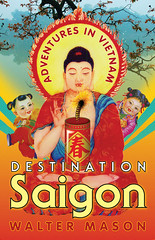
It took me years to discover the trick: don’t think about a book at all. Think about a story, a situation, a scene. When I finally wrote my first book, Destination Saigon, I rarely thought about the finished product when I sat down in my study, morning after morning, writing furiously to meet my deadline. I was working on a short piece, a piece which was to the fore of my mind and which was obsessing me. And pretty soon, piece by piece, I had 60,000 words – simple as that. Actually, I had way more than 60,000 and had to make some major cuts.

But as I was writing it was never a massive, monolithic, frankly terrifying book. I assembled it piecemeal, bit by bit, and slowly a book emerged, almost effortlessly. So stop letting the size of your book get in the way. Forget it’s even a book, and just keep your eyes on the road in front.

When you become obsessed with a story – one small, intricate and specific piece of a much-larger work – almost everything you do and read feeds into it and leads you back to it. “Why, that’s just like that chapter I’m writing right now,” you’ll find yourself saying as you read the paper or sing a hymn or deadhead the gardenias. And you’ll find yourself rushing back to that story because it’s so immediate, so raw, so absolutely in-your-head. Book? What Book? I’m writing a fantastic story, a short piece of tremendous power. I’m so excited about it I don’t have any time to think about the book I’m meant to be writing...oh wait...

There’s something about writing a book that seems so big, so terrifying. Writing books is what people like Dickens and Dostoevsky did. That’s a big job. Not me, I just write. For too long I carried that burden of the book around – the sense that I should have a really big project in mind, and not just lots of really interesting (and sometimes really good) pieces that got me excited. That idea constantly crushed me and stopped me from writing. I needed to free myself from the sense that I was embarking on something enormous, and instead concentrate on the fact that I was writing every day – that I had to write every day. And, who knew? Piece by piece, a book emerged.

And it will for you too, if you let go of the seemingly impossible end-goal, and glory in what you can produce right now.

Saturday, June 12, 2010

Liverpool Creative Writers


I had a lovely time today conducting a writing workshop for the Liverpool Creative Writers.
I have only just realised that this is the first writing workshop I have even conducted, and it was a great success.
We explored ideas of travel and journey, and how we might be able to apply some of the techniques of travel writing to other forms and genres.
As well as me talking we also did some practical exercises, at the end of which some of the group shared what they had written.
They were a really terrific bunch of people, and we all had lots of fun. So much so that I've already been invited back!

Thursday, May 27, 2010

Buddhist Sutras in Vietnam

Sutra recitation is the principal practice of Vietnamese Buddhism

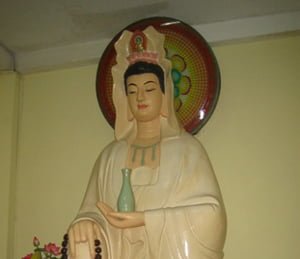
It is performed daily by monks and dedicated lay-people, and to sit in a monastery garden and listen to the heavenly sound of monastic voices chanting the scriptures, accompanied by bell and wooden drum, is one of my favourite things to do. Actually taking part in the chanting is a little more demanding, however. Though I am reasonably familiar with the liturgy (at one stage in my life I was a dedicated attender of evening sutra chanting), I still find the whole thing exhausting, involving as it does complicated shufflings of books and chanting sheets, bowing at the appropriate areas, and just keeping up with the sometimes dizzying pace of the chants. To complicate matters more, last time I was in Vietnam I was attending a Vajrayana temple in my suburb, where the whole practise of sutra chanting is ten-times more complicated. I was always doing something wrong, and being reprimanded by the elderly ladies who saw themselves as the guardians of correct conduct in the temple. So here is a list of sutras you will regularly encounter in the Vietnamese Buddhist context. I don't for a moment pretend to be a Buddhist scholar, so offer no analysis of the texts discussed. All I can do is describe them how I, in my ignorance, see them, and attempt to instruct you on when and how they are used. I'm happy to receive any corrections or further insights. 1. The Lotus Sutra: This is the grand-daddy of sutras in Vietnamese Buddhism. Most temples use this sutra as their fundamental text, and congregations chant their way through it a couple of times in the course of a year. Monks tell me that it offers the highest teaching of Mahayana Buddhism, and so can safely be taught across all sects and schools. Those of you familiar with Japanese Buddhism will be well aware of th importance of the Lotus Sutra in that culture as well. I have worked my way through it in English a couple of times, but will confess that it leaves more-or-less bewildered. I prefer chanting it in Vietnamese, where I don't feel obliged to make some kind of sense of it. 2. Kinh Pho Mon: I don't know what to call it in English. Basically it is the twenty-fifth chapter of the Lotus Sutra which sets out the special qualities of Kwan Yin Bodhisattva (Quan Am Bo Tat). Because of the great reverence Vietnamese Buddhists have for the Goddess of Mercy, this chapter is often printed as a stand-alone text, and is often recited in its entirety during special prayer sessions. 3. The Great Compassion Dharani: OK, so I know it's not a sutra, but it is long-ish, and is a central part of the Vietnamese Buddhist liturgy. It is chanted several times a day in monasteries, and is always a part of the formal prayer liturgy. I love the beautiful, meaningless sounds of this long mantra. A nun I know has it as the ringtone of her mobile phone. 4. Heart Sutra: Well-known in English, this short sutra is also chanted nightly, with its mantra of Gate Gate Paragate Parasamgate left in its original sanskrit. 5. Diamond Sutra: All monks know this sutra well and study it, though I can't recall ever having heard it recited. Most monks in Vietnam see themselves as connected to the Zen school, even if they don't practise meditation, and so this is an important text to them. 6. Metta Sutta: This Theravada sutra is much discussed in monastic circles, and praised as being applicable to all schools. It is worth noting that there is a sizeable Theravada minority in Vietnam, and that even Mahayana monastics spend some time studying Pali and the Theravada sutras - quite a unique situation in the Buddhist world, I should imagine. 7. Amitabha Sutra: While Pure Land belief and practice is almost universal among both monastic and lay practitioners in Vietnam, most temples eschew the study and chanting of the Amitabha Sutra, the principal text of the Pure Land school. There are, however, a very few monasteries which see themselves exclusively as Pure Land institutions, and so they chant this sutra in the evenings and teach from it. The numbers are actually growing because of the power, wealth and influence of Pure Land groups from Taiwan who pump a lot of money into Vietnam and encourage temples to be stricter about the teaching of Pure Land Buddhism. 8. Avatamsaka Sutra: After the Lotus Sutra this is probably the most revered text amongst serious Buddhists in Vietnam. Thich Nhat Hanh has a really beautiful audio series on this sutra called The Ultimate Dimension, and I can't recommend it highly enough.

Sunday, May 2, 2010

Self as Narrator, Self as Hero


One of the peculiarities of travel writing is that normally the central character of the narrator - the hero, if you like - is the writer himself.
I am talking here about the unnamed narrator of Destination Saigon, called variously, Big Brother, Fatty, Sir and – my favourite – Dumpling Face. He’s lazy, and disinclined to indulge in physical exercise – and there's something I recognise in that. He could be accused of being a religious maniac, except he’s never seen a religious person or religious act that he couldn’t poke fun at. There’s an inability to be serious, perhaps even a fear of the grave (and I leave the meaning of that statement intentionally unclear).
This character – this other Walter Mason – is also a big man, and I share this quality with him. The Vietnamese have the great charm of normally being completely honest and up-front. Being among them is like being in that awful film where no-one knows how to tell lies. Any faults, any physical differences, are immediately assessed and brought to the fore. My thesis is that this is a result of centuries lived in a communal culture in frequently crowded conditions. If everyone were to go about pretending not to notice things – the way we do – then society probably couldn’t function. People will introduce you to their family with such descriptions as “This is Sister Two – she’s retarded. Sister Three here is the great beauty of the family, but unfortunately that got used up by the time Sister Four came around – she’s extremely plain.” All this said not just in hearing distance of the said sisters, but in front of their faces. It might seem cruel, but after a while it is immensely liberating. You have no need to worry about what people are saying behind your back – because they are saying it in front of your back. If that makes sense.
And so my bigness is one of the badges I carry in Vietnam.
Related Posts with Thumbnails