Showing posts with label blogging. Show all posts

Wednesday, January 3, 2018

Thang Ngo — Blogging Your Interests Tuesday, 13 February 2018, 12:30pm at the Sydney Mechanics' School of Arts - FREE!


My own wonderful life partner Thang Ngo is giving a talk at the Sydney Mechanics' School of Arts in February that should interest all who want to document their travels.


Thang Ngo — Blogging Your Interests


We all have something we’re passionate about. Our interests can be as diverse as politics, food, fashion, music, gardening and more.

Blogging is a way of sharing your passion with the world and engaging with others who share your interests.

Well-known food blogger Thang Ngo will reveal how to use your passion to build an engaged community through blogging.

Learn tips, tricks and tactics for starting a successful blog and finding your niche, in addition to strategies for maintaining your motivation and building readership. Find out how blogging helps your career by developing your understanding of digital writing and social media.
FREE — Everyone Welcome

No Bookings Required


About Thang Ngo

Thang started blogging over 17 years ago as a local government Councillor in Fairfield to engage with constituents. In 2009, he started a food blog to celebrate the rich and flavoursome food of migrant eateries in his neighbourhood. Today, Noodlies is one of Australia’s most popular food blogs and is credited with helping fuel the popularity of Asian street food, such as Vietnamese pork rolls.
https://noodlies.com/

Monday, September 17, 2012

Monday Blogcrawl

Always yearning for Vietnam, with half my heart constantly there. Here are some things that caught my eye over the past week:


Vietnamese fishermen arrested for illegally fishing Thai waters


Friday, May 27, 2011

Commodifying the Buddha

The other day I came across quite a good post at Copyblogger called How the Buddha Solved His Marketing Problem.


It was all about using some of the principles of Buddhism to become a more effective marketer. Now, to me that's fine - in fact, kind of cool. But I know many among my Western Buddhist friends who would find such an approach reprehensible, and I got to thinking about the commodification of Buddhism in Western culture and the ways it may or may not be acceptable.
For a start the commodification of the Buddhist religion is not a recent phenomenon reflective of Western consumerist influence. Anyone who has visited functioning Buddhist temples in situ across Asia will realise that these are frequently commercial ventures relying on business practice to help them survive. Many temples charge tourists an entry fee, and many run all kinds of businesses, from bookstores and incense manufactories to vegetarian restaurants, farms and food distribution services. Monks frequently charge for their services, particularly when it comes to funeral celebrations and the blessing of new homes, enterprises and expensive objects.
In the West the principle example of Buddhist consumerism is the vast publishing industry that surrounds Buddhist teaching. It would seem that Western Buddhists are a remarkably literary bunch, and the flood of Buddhist-themed books and magazines, though decreasing in recent years, looks like it won't be ending anytime soon. And many of the most famous teachers are the most reliant on this publishing revenue. There is also the tricky issue of fees charged for teachings and retreats. These can often be considerable, particularly for the "big names" in Buddhism. Most of these activities are viewed askance by Asian Buddhists (and I am not going to enter the debate here about the terminology surrounding what you call people who are born Buddhists in a traditionally Buddhist culture).
Ten years or so ago in Australia there was quite a debate surrounding a mobile phone company that used the image of a Theravada Buddhist monk in its advertising. In this case people from all sides of Buddhism protested the gross insensitivity of using Buddhist imagery in the service of advertising and promotion. I remain silent on the issue.
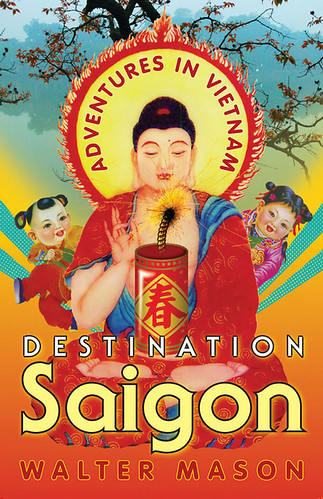
And where does that leave me? The cover of my book Destination Saigon is a striking collage of popular Buddhist imagery found in temples all over Vietnam.


Assembled by a talented, non-Buddhist (I assume) designer, it could be interpreted by some as irreverent, even irreligious. And it certainly exists for no reason but to enrich me and my publishing house (though I have been known to throw the odd dollar into the donation box in temples across the globe). Am I a gross exploiter of an anti-materialist religion?
Perhaps, perhaps...

Monday, August 2, 2010

Tips for the First Time Author #1 - Blog


Recently I have begun to teach some creative writing classes and I am also writing a monthly column on getting published for a small community magazine . This means that I am regularly asked questions about how to succeed as an author, or how to promote a book once it's written and published. I have also begun to receive really lovely emails from my readers, many of whom have their own writing ambitions and have asked quite specific questions. So I'd like to share with you some of the techniques for making your first book a success.

Number one in importance is: Blogging!

I understand that many established authors are not interested in blogging, or don't have the time. But for any new writer (particularly one who is not yet published!) blogging has become absolutely essential. If you haven't yet published it is an opportunity to collect a substantial body of work that publishers, agents and magazine editors can refer to and so discover for themselves what a literary genius you are. If you have been lucky enough to be published, it provides a way for you to build on what you have written, provide extra content for your readers and keep yourself in the public mind.

No matter where you are in the writing process, it is essential that you start blogging NOW - and keep at it regularly (once a week as a minimum). I am perplexed when I see some people advising not to start your blog until you are published. That is just bizarre. In my own experience, my profile as a blogger was one of the main reasons a publishing house decided to take me on.

There's nothing like a blog for turning you into a legend in your own lunch time, and it's amazing how impressive it can seem to those who are less technically savvy (and yes, that includes many editors, publishers and other industry people). And a blog gives you the perfect opportunity to cross-promote on Facebook and Twitter, making it seem as though you are incredibly prolific, busy and important. And that is exactly what any publishing house is looking for in an author.

Some people express a fear that the things they blog will be plagiarised. Yes, it's a risk, but you should be so lucky. Your major struggle will almost certainly not be being copied, but being noticed in the first place.

In her wonderful book The Frugal Book Promoter, author Carolyn Howard-Johnson also explains the importance of getting a good URL early on. Yes, it's most important to get started NOW, so sign up with Blogger or one of the others - it's easy to route teh blog you've started to your own URL later. But really, one of the first things you should be doing is buying the domain names for your own name (if still possible) and your next book's title (once you know for sure). This is inexpensive and easy.

Some people say they don't know what to blog about - they are afraid of losing privacy or, worse, appearing egotistical. If those are genuine concerns, then may I respectfully suggest that you are in the wrong game. The age of the shy and retiring writer has long gone - J. D. Salinger would never make it in the 21st century, for better or for worse. Yes, you will lose some privacy, but only as much as you choose to sacrifice. And yes, some people will accuse you of being egotistical. Such critics are normally distinguished by their complete lack of success in the world. Bless them and move on.

More and more publishers are expecting their authors to blog and to maintain a presence on social media. And the fact is that surprisingly few do it. If you get started now, and do it well, you place yourself in a privileged - and even cherished - minority.
Related Posts with Thumbnails