Showing posts with label Buddhist. Show all posts

Friday, August 17, 2012

Monastic Communities


Buddhist monastic communities are still very much alive in Vietnam, though the numbers of young monks have dwindled rapidly from their heyday twenty years ago when Vietnam was desperately poor and entering a monastic institution was seen as a guarantee of a comfortable and predictable life. Now that Vietnam has well and truly entered the consumer age young people are less willing to embrace a life of renunciation, celibacy and physical hardship in exchange for predictable food and quality education. 


The Baby Buddha, Tinh Xa Trung Tam, Ho Chi Minh City


And because the predominant form of Buddhism in Vietnam is Mahayana, there is none of the temporary ordination that you see in neighbouring countries like Cambodia and Laos, which swells the ranks of monks quite deceptively with young men and makes for all those charming pictures of monks that people take back home after their holidays. 


Monk blessing people, Battambang, Cambodia


In the Vietnamese tradition you take the monks’ robes for life, so young men take the decision a good deal more seriously. 


The internet has been abuzz for the past week or so with stories of a gang of Buddhist monks in Korea caught on camera drinking, smoking and gambling. It would be extremely naive to think that such things don’t go on in Vietnam. Of course they do. Drinking is completely verboten, but back in the 90s I knew young monks who consumed beer at parties. When I questioned them about this, they maintained that the ban was on strong forms of liquor like vodka and whiskey. Beer, they maintained, was only a mild intoxicant and so not technically wrong. Absolute nonsense, of course, but it was a common deception. 


In the 80s and 90s I would say that most monks in Vietnam smoked, though I have noticed that in recent years this is increasingly frowned upon, and many of my old monastic companions have given up for the sake of propriety. The disapproval of lay people had simply grown too strong. I can honestly say I have never witnessed monks gambling. I think that gambling is such a real and ever-present social problem in Vietnam, one which regularly destroyed the lives of the people they ministered to, that they were not capable of giving it any kind of saffron-wash. 


One sees now, more and more often, clips of Buddhist monks on Youtube doing inappropriate things, like dancing, staring down women’s blouses or even, in the case of one Thai monk, vouging. Of course, these things are all forbidden by the Vinaya, the enormous code of ethical conduct for monks devised by the Buddha many centuries ago.  This is a fascinating document, going into the detail t hat it does about what monks should or shouldn’t do. The list is exhaustive and seemingly random – most scholars assume it was created in reaction to infringements by monks living in the Buddha’s day, or the complaints of scandalised lay people. 

And so it is that rules exist forbidding monks, for example, to climb trees, or to roll rice up in balls and throw it into their mouths, or to eat with an “mmmph mmmph” sound. So extensive is the list of forbidden activities in the Vinaya that it is almost impossible for any human being to uphold them all, and most monks don’t even try. The Buddha himself knew this, and said that if a monk could abide consistently by every rule established he would be immediately enlightened. Suffice to say that enlightenment among monks is still pretty thin on the ground.

Wednesday, June 6, 2012

States of Rebirth

Today I was wandering through the streets of Cabramatta when I spied, in a big pile on a shelf of free Buddhist literature outside a vegetarian supermarket, this laminated leaflet:


It transported me instantly back to Vietnam, where this particular poster is very commonly encountered, particularly in the guest rooms at temples and on the walls of vegetarian restaurants.
It is a chart of the various states of rebirth we might hope to attain.
Now of course, some of those staes of rebirth are in hell, where the wicked must pay for their torments.
This used to be a decorative motif much beloved of Buddhist temples, though it seems to have become unfashionable in recent years, and many temples have painted over their vivid wall murals depicting the various torments of hell.
I found some intact, however, at the Vietnamese Buddhist temple in Phnom Penh.


And while in Siem Reap I visited the truly ghastly Cambodian Culture Village, where the only thing even mildly amusing was the "Tunnel of Judgement" featuring 3D renderings of the punishments infliced on the evil in the hell realms.
These dioramas were a kind of torture porn, and of all the photos I took this is the ony one I can show safely on a PG rated blog:

Friday, August 12, 2011

Friday, May 27, 2011

Commodifying the Buddha

The other day I came across quite a good post at Copyblogger called How the Buddha Solved His Marketing Problem.


It was all about using some of the principles of Buddhism to become a more effective marketer. Now, to me that's fine - in fact, kind of cool. But I know many among my Western Buddhist friends who would find such an approach reprehensible, and I got to thinking about the commodification of Buddhism in Western culture and the ways it may or may not be acceptable.
For a start the commodification of the Buddhist religion is not a recent phenomenon reflective of Western consumerist influence. Anyone who has visited functioning Buddhist temples in situ across Asia will realise that these are frequently commercial ventures relying on business practice to help them survive. Many temples charge tourists an entry fee, and many run all kinds of businesses, from bookstores and incense manufactories to vegetarian restaurants, farms and food distribution services. Monks frequently charge for their services, particularly when it comes to funeral celebrations and the blessing of new homes, enterprises and expensive objects.
In the West the principle example of Buddhist consumerism is the vast publishing industry that surrounds Buddhist teaching. It would seem that Western Buddhists are a remarkably literary bunch, and the flood of Buddhist-themed books and magazines, though decreasing in recent years, looks like it won't be ending anytime soon. And many of the most famous teachers are the most reliant on this publishing revenue. There is also the tricky issue of fees charged for teachings and retreats. These can often be considerable, particularly for the "big names" in Buddhism. Most of these activities are viewed askance by Asian Buddhists (and I am not going to enter the debate here about the terminology surrounding what you call people who are born Buddhists in a traditionally Buddhist culture).
Ten years or so ago in Australia there was quite a debate surrounding a mobile phone company that used the image of a Theravada Buddhist monk in its advertising. In this case people from all sides of Buddhism protested the gross insensitivity of using Buddhist imagery in the service of advertising and promotion. I remain silent on the issue.
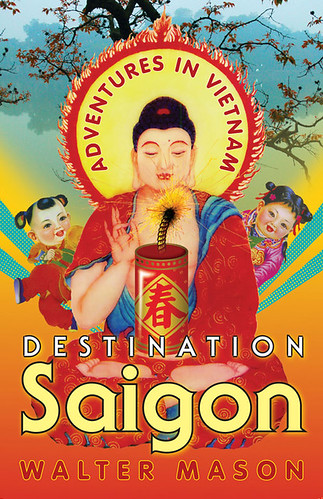
And where does that leave me? The cover of my book Destination Saigon is a striking collage of popular Buddhist imagery found in temples all over Vietnam.


Assembled by a talented, non-Buddhist (I assume) designer, it could be interpreted by some as irreverent, even irreligious. And it certainly exists for no reason but to enrich me and my publishing house (though I have been known to throw the odd dollar into the donation box in temples across the globe). Am I a gross exploiter of an anti-materialist religion?
Perhaps, perhaps...

Friday, January 7, 2011

My Guide to Vietnam: Interacting With Buddhist Monks and Nuns

Most visitors to Vietnam will encounter monks and nuns.

Buddhist temples make up a big part of the itinerary for any visitor to Vietnam, and almost all of these places are living, thriving monastic communities.


You will witness monks and nuns wandering about attending to their duties, and for most they remain mysterious, exotic and ever-so-slightly glamorous figures.


Any reader of Destination Saigon will know that Buddhist monks and nuns are a big part of my world, both in Vietnam and Australia, and have been so for many years.


People often ask me how they should behave in the presence of monastics, so here is a bit of advice.
Whenever you encounter monks or nuns you should greet them in the traditional Buddhist manner, with your hands clasped in the "prayer" position, at the chest.


In Vietnamese this is called chap tay, and it is a lovely tradition that is steeped in symbolic meaning. Thich Nhat Hanh writes about it, comparing the clasped hands to a lotus bud. By placing our hands together at our chest and bowing slightly (no need to over-do it), we are honouring and respecting the other person - Thich Nhat Hanh says the Buddha in me is greeting the Buddha in you, or "a lotus to you, a Buddha-to-be." Monks greet each other in a similar fashion, as do lay-people when they are at temple. In Vietnam the chap tay is reasonably uncomplicated - you simply make the gesture at chest level, no matter who you are or who you are meeting. In other South-East Asian countries it is altogether more tricky, and you have to raise your hands to different levels depending on what you are doing and who you are encountering. I invariably do it wrong. To make matters worse, the conventions are ever-so-slightly different in Thailand, Laos and Cambodia, so that what was ok in one place becomes a gaffe in another.
When Buddhists make the chap tay gesture they also normally say Mo Phat, which is an abbreviated version of the mantra Nam Mo A Di Da Phat, which means "Hail Amitabha Buddha." If you can master these two actions, you will be an instant member of the Buddhist community in Vietnam!
If you see monks or nuns, do smile at them and greet them – most foreigners ignore them - mostly because they they are shy, I suspect, or worried that they may say or do something wrong. Perhaps they are also concerned that a monk is not to be bothered with foolish tourists and everyday gestures. But believe me, they love it when someone is friendly towards them
, especially a foreigner. Monks and nuns in Vietnam are frequently well educated and can sometimes speak good English, so do try to connect.

Of course, there are a couple of simple dos and donts when it comes to interacting with them:

  • Avoid physical contact, especially if they are of the opposite sex.
  • Dress respectfully, especially if they invite you to a special event - this goes for men and women - no shorts and only shirts with sleeves.
  • Be careful of violent acts - most monastics in Vietnam are strict vegetarians, and things like swatting at mosquitoes and squashing ants, which we do instinctively, can actually upset them.
  • Don't visit the temple if you have been drinking.
  • Don't arrange meetings at cafes, hotels, shopping centres or other places of secular entertainment - generally their vows don't allow them to go to such places. You can meet at temples, bookshops and vegetarian restaurants instead.
  • Don't give them tasks or errands, or ask them to pass on messages or gifts. Their vows actually forbid this.
  • Offer them money, by all means, but do it discreetly - always put the money in an envelope. It also helps them if you tell them what the money is for e.g. "This is for you" or "This is for the temple." Generally they are bound to use the money in the way the lay-person intends, so make it easy for them. If they refuse a monetary gift, you can always insist and say it's for the temple, or for charity, in which case they must accept. What do nuns and monks need money for? I hear you ask. Well, books, study-fees, transport, food - most rely entirely on private sponsors just to survive, so your gifts will always be needed. If you ask them what they want, please be clear about the amount you want to spend, as this saves awkward situations. If you are ofering to buy them $30 worth of books, say so, so they will know not to ask for $10,000 for a temple extension. This might seem all very mundane and worldly, but it is, in fact, the kind of thing that local lay-people do in their own interactions with the religious.
  • If you see a monk or nun in a bookstore, offer to pay for their purchase. You can also do this in a vegetarian restaurant. If they are already in the company of lay-people, however, it's probably best not to do this, as they are probably already being looked after, and you don't want to embarrass anyone.
  • Gifts for monastics: apart from cash, you can offer tea (especially imported), live plants (esp. orchids), cut flowers, fruit, books (they love Buddhist books in English), stationery, Buddhist religious images and paraphernalia (especially from other countries), incense (expensive or imported only), candy and cartons of soft-drink or vegetarian packet noodles.

Wednesday, November 10, 2010

Nuns Chopping Firewood, Ho Chi Minh City


I found this beautiful old photo that I took back in 1996.
I don't remember where this particular nunnery was, but it was somewhere in the suburbs of Ho Chi Minh City. It was in a side street, and by chance I was riding past in a cyclo and I got the driver to stop so I could check out the temple. When I peered in through the closed gate I saw the nuns hard at work chopping firewood. One of them let me in to the courtyard, and they all giggled as I photographed them at their hard, hot work. One of the sisters put on a proper outer robe and took me into the prayer hall so I could pay my respects to the Buddha.
In Destination Saigon I write about this industriousness much in evidence in nunneries in Vietnam. Traditionally, women's communities have attracted less lay support than men's, and so the nuns have always relied on some form of industry to keep their temples going. The chopping and selling of firewood is quite unusual work - though I do know of a men's community in Phu Nhuan who have a full-scale lumberyard in operation! Nunneries more typically manufacture incense, produce vegetarian delicacies for re-sale, make rosaries, sew religious clothing, produce and copy Buddhist CDs and DVDs and operate vegetarian restaurants. Ironically, this has seen women's communities grow prosperous, particularly in the bigger cities.

Friday, July 16, 2010

A Di Da Phat


The name you will hear most consistently if you spend any time in Vietnamese Buddhist temples is that of Amitabha Buddha - or A Di Da Phat in Vietnamese.
The vast bulk of Vietnamese Buddhists practise a basic form of Pure Land Buddhism, and for the most part the monks advocate recitation of Amitabha's name as the most effective form of religious practice for lay-people. This is what all of those wrist malas and long prayer beads are for.
Within the temple, Amitabha's name is also a kind of shorthand replacement for everything. When you say hello, you say A Di Da Phat, when you say goodbye, when you want to attract someone's attention and when you express surprise. Once I was at temple when one of the large vases that are found in the main prayer hall tumbled over and smashed, and a number of monks looked up and exclaimed, as one, A Di Da Phat!
The true form of Buddha recitation is, of course, Nam Mo A Di Da Phat. This is enunciated clearly during communal temple worship, but at other times it is shortened to Mo Phat, and this is in fact the standard greeting amongst Buddhists, both monastics and laity.
Despite his name being constantly on everyone's lips, statues of Amitabha Buddha are not normally very prominent at temples. It is rare to have him as the main object of devotion in the prayer hall, and he is rarely seen on other shrines. Normally there is a printed image of him on the wall in the monks' offices, or a small statue on a shelf somewhere. People seem to set much greater store on statues of Kwan Yin and Sakyamuni Buddha.
One place where an image of Amitabha does become important is at people's death beds, which is why monks always have a small-ish statue of him to hand to take to hospitals and houses of the faithful, should the need arise. It is thought that if the dying person lays eyes upon an image of Amitabha, they will be reborn in his paradise.
The image with this post is from a very unusual Amitabha tower at Hien Nam Pagoda in Quy Nhon. This is the only construction of its kind I have seen in Vietnam, an 8-storied pagoda with large statues of Amitabha looking out over the four directions on each storey. It is quite beautiful, and was designed by the Abbott himself.
Related Posts with Thumbnails