Showing posts with label Tinh Xa. Show all posts

Wednesday, February 17, 2016

Tinh Xa Trung Tam, Binh Thanh District, Ho Chi Minh City


Tinh Xa Trung Tam has a special place in my heart because it is the first temple in Vietnam that I ever had any real connection with. In the mid-90s I was a student of a monk in Australia who was a part of the order, and so I visited Vietnam with the special intention of studying more here and learning about this distinctive form of Vietnamese Buddhism.


Master Minh Dang Quang

Tinh Xa Trung Tam is one of the centres of worship for the Tang Gia Khat Si, an indigenous Buddhist order founded by Master Minh Dang Quang. There is an excellent Wikipedia entry for this temple which explains its history and a little about the Order and its founder (I would actually love to hear from whoever wrote it) which you should read.

I have spent many days in this temple and its surrounds, though these days when I go back to Vietnam I probably only visit once or twice to say a prayer and soak in some of the memories of my youth.

I am still quite fascinated by the Order's founder, a Mekong Delta monk called Minh Dang Quang who attempted to unify the Theravada and Mahayana schools of Buddhism and re-write the scriptures in colloquial Vietnamese. As at every Tinh Xa (the Vietnamese version of "Vihara" which is what the Tang Gia Khat Si temples are called, as opposed to the Mahayana temples which are called Chua in Vietnamese), there is a shrine to the Master, and this one also contains some of his relics.


Shrine to Master Minh Dang Quang, his relics in cabinet below

On a weekday afternoon there is rarely anyone inside the main shrine, and it is a great place to sit quietly and meditate, or to do a round or two of quiet recitation of the Buddha's name.

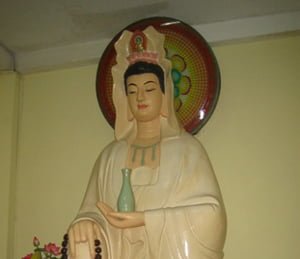
Outside there is a famous, and enormous, statue of Kuan Yin, the Bodhisattva of Mercy (Quan The Am in Vietnamese). It is a very popular object of worship, and throughout the day people come into the monastery grounds to make their own prayers at its base.


Statue of Quan The Am, Bodhisattva of mercy

The temple was built in the 60s, and visiting recently with an architect I was informed that it was a classic piece of American-era architecture, especially in its liberal use of pebble-crete. The main hall is built in the octagonal shape of all Tinh Xas, symbolising the Noble Eightfold Path of the Buddha. Over the years the surrounding buildings have been demolished and rebuilt, and I fear that the same fate awaits the main hall, which would be a shame.

Tinh Xa Trung Tam in Binh Thanh claims to be the main temple of the order, but it's worth mentioning that the order did break up into different sects in the 60s and there are a couple of other Tinh Xas around that claim to be Trung Tam (The Central). 

Just outside the main gates of the temple is a little bookshop, and a small gift stall next to it. The bookshop is run by the loveliest man, though sadly there are no books in English. If you have any Buddhist friends in Vietnam, though, or plan to make some, this is a great place to buy gifts. Publishing in Vietnam is vibrant, and books are beautifully designed and cheap. I always buy a bag-full and manage to distribute them easily.

You can find the temple at:

7 Nguyễn Trung Trực Street, Bình Thạnh District, Ho Chi Minh City.

It is about a 25 minute taxi ride from downtown Saigon (outside of peak hours) and is well worth a visit.
It is hidden down several lanes, so be prepared for your driver to stop and ask for directions along the way.

 In October/November this year I am once again leading a tour of Vietnam, from Hanoi all the way down to the Mekong Delta. This will be a fantastic journey, and I'd love to have you along.

Saturday, November 6, 2010

Tinh Xa Ngoc Huong - Hue


One of my favourite places in Hue is the sleepy and little-visited monastery in the Old City called Tinh Xa Ngoc Huong.


It is situated on an island, and legend has it that this was once the site of the emperor's library. I'm not sure how it came to be held by the Tang Gia Khat Si, the indigenous mendicant Buddhist order, but they still have it, and the only way to get to it is via a long, narrow cement bridge over a lake. The monastery sits all on its own on the little island in the middle, quite decrepit and rarely attended.


It's a glorious little piece of old Vietnam.
I have something of an histoire with the temple. Back in 1996 I was a devout young Buddhist travelling Vietnam in the company of an eccentric Australian-Vietnamese monk who had recently ordained in the order. You must understand that the Khat Si, the indigenous Buddhist order, is still very much a religious minority in Vietnam, and is looked down upon by those who are part of the more established Mahayana mainstream. The little monastery in Hue represented at that time the order's northernmost outpost, and I'm sorry to report it wasn't doing well. It was run by an exceedingly curmudgeonly old monk who terrorised the younger monks, the temple staff and any lay-person brave enough to visit.
I had been instructed to go to the temple and stay for a while, and as soon as I arrived the old monk turned me into his personal ATM and part-time slave. I had to take him to the dentist (and pay for it), go shopping at the market for better quality food than they were used to (the temple was terribly poor), hang around all day for prayer sessions (which were often cancelled because they were all so lazy), and fend off the troops of beggars who would come scooting over the footbridge when they heard there was a foreigner there.
On days when the old monk's teeth were hurting (and he did suffer terribly, the poor old fellow) a big roll of razor wire would be tossed across the footbridge and nobody would be allowed in or out. We would skulk quietly around the damp, filthy temple and wait for the mealtimes. The temple employed a single servant, a rough-voiced, sullen midget whose gender was completely impossible to guess. After a couple of weeks I still had no idea. This poor person was screamed at, berated and occasionally hit by the old monk in his fury at various incomprehensible offences.
Apart from beggars, no-one at all came for prayer services. The good Buddhists of Hue were largely orthodox in their observance, and had no interest in the strange little cult occupying such a picturesque location. Oddly, an order of nuns belonging to the same sect lived a block away, and the good sisters kept a ship-shape temple. They made incense which they sold all over the country, and their prayer hall was gleaming and constantly being renovated and enlarged. Ours was literally rotting away, and parts were quite dangerous. The monks refused to engage in any type of commerce because the strict rules of the Order forbade it. So they festered in the most miserable poverty, relying on the kindness of the nuns who would advance them money occasionally.
When I was last in Hue I visited the Tinh Xa once again, and was surprised to see that a number of changes had been made. The place was looking positively respectable. The old footbridge had been replaced with a much wider and sturdier model.


The buildings had all been re-rendered and freshly painted.


Still, the whole place was locked up, and the only monk I saw was someone I didn't recognise.
I thought of dropping by the monks' quarters and asking after the old man, but I was with friends, and they were spooked by the place. "Why on earth would you want to come visiting a damp old dump like this?" asked my Vietnamese friend, clearly unimpressed by the romantic surroundings.
The prayer hall was locked, so I stood outside and peered in at the statue of the Patriarch and said a quick, perfunctory prayer. I remembered the old monk's teeth, the poor midget who cooked the dreadful meals, and the lines of sad beggars and neer-do-wells who would visit me day after day with their sad stories.
I blessed them all, and I went back to my hotel.

Details:

Tinh Xa Ngoc Huong
Le Van Huu St
Old City, Hue, Vietnam
Related Posts with Thumbnails