Showing posts with label architecture. Show all posts

Monday, April 28, 2014

Quan Am Pagoda, Phu Nhuan


One of the places I find myself constantly recommending people visit is the little-known Quan Am Pagoda in Phu Nhuan District, Ho Chi Minh City.


This temple is also mentioned in my book, Destination Saigon, and I have been visiting there for almost 15 years now.


It is a pretty basic suburban temple, but it was the Saigon residence of Thich Quang Duc, and as I mentioned in a previous post, it has become something of a shrine to him.
Downstairs is a large shrine to Thich Quang Duc Bodhisattva and the other Buddhist martyrs that followed him - most people don't realise that many people, both monastic and lay, followed his example and set fire to themselves in protest to the war.


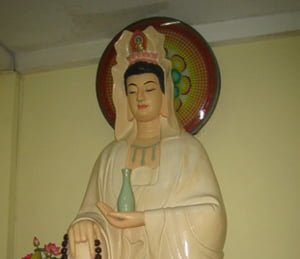
There is also a large and very kitsch grotto housing a quite unique shrine to Quan Am (Kwan Yin). This particular shrine is very popular with locals, and the statue of Quan Am is quite unique, in a form rarely seen.


To get to the grotto you need to walk through the gift shop to the left of the temple, and then climb up through the fake cave. Offerings are made from behind the statue. This grotto is exceedingly cramped, and should you meet someone on your way up or down one of you is going have to re-trace your steps - it is almost impossible to pass another person.

Details: Chua Quan Am - Phu Nhuan, 90 Thích Quảng Đức St, Phu Nhuan, Ho Chi Minh City

Saturday, November 17, 2012

Tan Dinh Church, District 3, Ho Chi Minh City

News about Vietnam rarely includes mention of the numerous sleepy, crumbling French Colonial churches that are to be found in every city and large town. Tourists mostly just drive by them, and to the local Vietnamese (unless they are parishioners) they are exotic remnants of a largely unknown past. I took my friend Kien - a Saigon native -  with me when I visited Tan Dinh church, and it was the first time he'd ever been inside a Catholic church.


In Ho Chi Minh City there are only a couple of these French Colonial beauties left - most of the really big Catholic churches were built in the 60s and 70s, and have a distinctive and quite groovy architecture all of their own.


Tan Dinh Church in District 3 is probably my favourite of the French churches.
It is always painted a vibrant and unexpected colour - salmon pink, orange, a kind of biscuit-colour, baby blue and mint green. The aesthetic eye overseeing this church's exterior is distinctly camp.


Inside it is largely untouched. Lots of faux-baroque statuary, a shrine to Saint Therese of Lisieux (the only one I know of in Vietnam), a shrine to St. Martin de Porres (there is one of these in every second church) and one to the Vietnamese martyrs (also reasonably common).


Unlike the infuriatingly chained-up Nha Tho Duc Ba in central Saigon, Tan Dinh church is always open, and is well worth checking out.
It is also situated right near Tan Dinh market, which is THE place to buy fabrics in Ho Chi Minh City. If you are searching for linens and cottons (reasonably rare at other markets), then this is the place to go (heads up - I always go to ABC Fabric).
There is also a doughnut shop just before the church called The Gioi Donut, and I have been known to drop by there ;-)


Tuesday, August 7, 2012

Cao Dai

When I was in Vietnam I had had several sad and frustrating trips to Tay Ninh, all alone. I had decided not to visit anymore, though I was fascinated by Cao Dai. But just before I left I finally relented and accepted a standing invitation from a friend to re-visit Tay Ninh. I had had such an unpleasant time there before that I was really reluctant to, but he was a devout believer in Cao Dai and he had his own motorcycle, so it was too good an opportunity to miss.
I am so glad I did it - I really had an opportunity to explore Tay Ninh, which is such an intriguing city with such an extraordinary past. And doing it with someone who was a follower of Cao Dai really opened up the religious world of Tay Ninh to me. About 80% of the residents of Tay Ninh belong to the Cao Dai faith, and most of those are observant and manage to get along to temple at least once a week. Most tourists are familiar with the Cathedral there (one of the most popular day trios from Saigon, the midday prayers can become dangerously packed with tourists looking for a colourful photo opportunity), but the Holy City itself is actually a vast complex containing many different chapels and lecture halls. It is slowly being renovated and restored to its former glory, and this resurgence of the Cao Dai spirit reminds one of what a force it used to be in South Vietnam, back in the day when it could boast of its own army.
Cao Dai as a concept is almost impossible to resist. An attempt to fuse the ideas of the great religions and philosophies of the world, Cao Dai is just so colourful and so wacky and so entirely Vietnamese that it can't help but be completely charming.
And the prayer sessions themselves are quite moving, filled as they are with pomp and ritual. There is a moment of complete stillness at the end of prayers that is absolutely transcendent, and makes one think that just possibly there is a meeting point between heaven and humanity, between God (represented by the all-seeing eye) and Her creation.

Tuesday, March 20, 2012

A Vietnamese Temple in Phnom Penh


There was once a large Vietnamese population in Phnom Penh.
When I first visited in 1996 I heard Vietnamese spoken often on the streets. Restaurant owners, cafe proprietors, market-stall holders - all were frequently Vietnamese. The city boasted several Vietnamese Mahayana temples with resident monks, as did outlying areas.
This has been gradually changing. More and more Vietnamese return home, despite having lived in Cambodia for a generation. The Vietnamese temple close to Olympic Market is the last one I know of in the inner-city area, and that seems to be on its last legs. Of course, no-one knows where it is, and most Tuk-tuk and moto drivers will tell you that there is no Vietnamese Wat in Phnom Penh. The only one they know of is in a fishing village about 15 kilometres outside of the city. I knew it was there somewhere, though, and eventually I went out to the Vietnamese restaurant next to the Mai Linh bus stop that sells tickets to Ho Chi Minh City. The kindly owner affirmed there was a Vietnamese temple nearby, and the waiter drove me there on the back of his bike, having stopped to ask directions several times.


When I visited last year there was still a resident monk, albeit a very grumpy and not particularly outgoing one. But even he has left, leaving the temple more or less deserted. The temple-keeper seems to be an 18 year-old boy, helped by some of the surrounding families and kept company by a shifting cast of ne'er-do-wells that sleep in hammocks in the prayer hall.
It's a shame, because it is a beautiful little place, displaying a unique amalgamation of the two religious styles. The usual wall murals common in Theravadin temples across Southeast Asia are here, but with the addendum of murals depicting Mahayana concepts of hell and the cultivation of merit that one might see at a Chinese or Vietnamese temple.
The main shrine contains the usual Vietnamese mix of Buddhas and Bodhisattvas, but also a Khmer-style image of the Buddha that you would never encounter in Vietnam.


Outside the temple are a number of small shrines, including one devoted to a local Goddess from Ca Mau in Southern Vietnam - I have never encountered her before.


The temple is well worth a visit, though prepare for a struggle to find it. It is actually centrally located - it's just that no-one knows about it.


Ask the driver to take you to Wat S'nyay (Wat Vietnam).
He may not know where it is, in which case ask him to take you to Street #134 and ask directions from there.

Monday, February 6, 2012

Bitexco Tower, Ho Chi Minh City

I have a confession to make. I am not particularly enamoured of big towers.
My Freudian readers can make of it what they will, but I am largely uninterested in the enormous concrete and steel erections that seem to be springing up all over Asia.
But I couldn't resist a trip up Saigon's new-ish Bitexco Tower, a quite beautiful building that is the tallest in Ho Chi Minh City and is said to symbolise a lotus bud.


Saigon hair stylist Kien Nguyen and a pictorial representation of Bitexco Tower inside Bitexco Tower. Very po-mo.


I don't quite see the bud myself, but it is nonetheless a striking-looking building that stands out in a reasonably low-rise city.
Getting up costs around $10, which is a bargain by big tower standards (you need to mortgage your house to take a trip up Sydney's sad old Centerpoint Tower).
Once up there it is cool and slick and almost empty. My Vietnamese companions loved the outing, though they were perplexed by what they saw - the Vietnamese inability to read maps (it doesn't seem to be taught in schools) meant that viewing the city from this elevation seemed to confuse them.


The view over Saigon from the Bitexco Tower


There is also a monster telescope which is meant to be amazing at night, but apparently is useless doing the day.


Kien Nguyen checking out the big telescope


The standard telescopes arranged around the viewing tower are free to use and excellent.
It's actually quite fascinating to view this constantly developing city from above, and I think it was money well spent.

Cute tattooed Japanese guy we flirted with

The boys pose for a shot outside the tower inside the tower. I love this stuff.


The Bitexco Tower (centre) viewed from a ferry on the Saigon River
My friend Hai looking out over Saigon from the Bitexco Tower observation deck
Go now before the locals discover it and it becomes insanely crowded.


Saturday, November 6, 2010

Tinh Xa Ngoc Huong - Hue


One of my favourite places in Hue is the sleepy and little-visited monastery in the Old City called Tinh Xa Ngoc Huong.


It is situated on an island, and legend has it that this was once the site of the emperor's library. I'm not sure how it came to be held by the Tang Gia Khat Si, the indigenous mendicant Buddhist order, but they still have it, and the only way to get to it is via a long, narrow cement bridge over a lake. The monastery sits all on its own on the little island in the middle, quite decrepit and rarely attended.


It's a glorious little piece of old Vietnam.
I have something of an histoire with the temple. Back in 1996 I was a devout young Buddhist travelling Vietnam in the company of an eccentric Australian-Vietnamese monk who had recently ordained in the order. You must understand that the Khat Si, the indigenous Buddhist order, is still very much a religious minority in Vietnam, and is looked down upon by those who are part of the more established Mahayana mainstream. The little monastery in Hue represented at that time the order's northernmost outpost, and I'm sorry to report it wasn't doing well. It was run by an exceedingly curmudgeonly old monk who terrorised the younger monks, the temple staff and any lay-person brave enough to visit.
I had been instructed to go to the temple and stay for a while, and as soon as I arrived the old monk turned me into his personal ATM and part-time slave. I had to take him to the dentist (and pay for it), go shopping at the market for better quality food than they were used to (the temple was terribly poor), hang around all day for prayer sessions (which were often cancelled because they were all so lazy), and fend off the troops of beggars who would come scooting over the footbridge when they heard there was a foreigner there.
On days when the old monk's teeth were hurting (and he did suffer terribly, the poor old fellow) a big roll of razor wire would be tossed across the footbridge and nobody would be allowed in or out. We would skulk quietly around the damp, filthy temple and wait for the mealtimes. The temple employed a single servant, a rough-voiced, sullen midget whose gender was completely impossible to guess. After a couple of weeks I still had no idea. This poor person was screamed at, berated and occasionally hit by the old monk in his fury at various incomprehensible offences.
Apart from beggars, no-one at all came for prayer services. The good Buddhists of Hue were largely orthodox in their observance, and had no interest in the strange little cult occupying such a picturesque location. Oddly, an order of nuns belonging to the same sect lived a block away, and the good sisters kept a ship-shape temple. They made incense which they sold all over the country, and their prayer hall was gleaming and constantly being renovated and enlarged. Ours was literally rotting away, and parts were quite dangerous. The monks refused to engage in any type of commerce because the strict rules of the Order forbade it. So they festered in the most miserable poverty, relying on the kindness of the nuns who would advance them money occasionally.
When I was last in Hue I visited the Tinh Xa once again, and was surprised to see that a number of changes had been made. The place was looking positively respectable. The old footbridge had been replaced with a much wider and sturdier model.


The buildings had all been re-rendered and freshly painted.


Still, the whole place was locked up, and the only monk I saw was someone I didn't recognise.
I thought of dropping by the monks' quarters and asking after the old man, but I was with friends, and they were spooked by the place. "Why on earth would you want to come visiting a damp old dump like this?" asked my Vietnamese friend, clearly unimpressed by the romantic surroundings.
The prayer hall was locked, so I stood outside and peered in at the statue of the Patriarch and said a quick, perfunctory prayer. I remembered the old monk's teeth, the poor midget who cooked the dreadful meals, and the lines of sad beggars and neer-do-wells who would visit me day after day with their sad stories.
I blessed them all, and I went back to my hotel.

Details:

Tinh Xa Ngoc Huong
Le Van Huu St
Old City, Hue, Vietnam

Sunday, April 4, 2010

The Houses of Ho Chi Minh City


Ho Chi Minh City is crowded by anyone's estimation.
Officially the population of the city is 9 million, though most experts say there are a couple of million on top of that. Even a cursory glance at the city's population will reveal that almost everyone you meet, and certainly everyone that works for you or serves you, is not officially a resident, so heaven knows how many people are actually living there.
It is crowded and cramped, and real estate has become insanely expensive - buying a house in the city area is far more expensive than buying a house in Sydney, for example, but people earn only a fraction of what people in Australia earn, so in real terms the cost of housing is truly astronomical.
So people tend to build up. Every time I return to Vietnam people in "The City" have added another floor to their houses, and long, steep and perilous stairways are very common in urban Saigon dwellings.
One stumbles upon some quite extraordinary architecture, and a distinct "Saigon" look has emerged in the last few years. I love buying all the Home Beautiful style magazines when I am there to see how the rich are building and decorating their often quite tiny homes.
Getting around in Ho Chi Minh City can be quite difficult, with houses hidden down a bewildering series of alleys, leaving you looking for addresses like 1/6/31/8/ bis Pham Van Hai. Each number indicates an alley you need to turn down, and heaven help you if you make a wrong turn - re-tracing your steps can take up a lot of time, and leave you emerging into streets and districts you've never seen before.
The residents of Saigon, too, are inveterate shopkeepers, and houses frequently feature a business of some sort in the downstairs front room. Frequently, in order to get to an actual house, you have to tramp through the premises of a cafe, a pharmacy or a dressmaker.
Related Posts with Thumbnails