Showing posts with label shrines. Show all posts

Wednesday, February 17, 2016

Tinh Xa Trung Tam, Binh Thanh District, Ho Chi Minh City


Tinh Xa Trung Tam has a special place in my heart because it is the first temple in Vietnam that I ever had any real connection with. In the mid-90s I was a student of a monk in Australia who was a part of the order, and so I visited Vietnam with the special intention of studying more here and learning about this distinctive form of Vietnamese Buddhism.


Master Minh Dang Quang

Tinh Xa Trung Tam is one of the centres of worship for the Tang Gia Khat Si, an indigenous Buddhist order founded by Master Minh Dang Quang. There is an excellent Wikipedia entry for this temple which explains its history and a little about the Order and its founder (I would actually love to hear from whoever wrote it) which you should read.

I have spent many days in this temple and its surrounds, though these days when I go back to Vietnam I probably only visit once or twice to say a prayer and soak in some of the memories of my youth.

I am still quite fascinated by the Order's founder, a Mekong Delta monk called Minh Dang Quang who attempted to unify the Theravada and Mahayana schools of Buddhism and re-write the scriptures in colloquial Vietnamese. As at every Tinh Xa (the Vietnamese version of "Vihara" which is what the Tang Gia Khat Si temples are called, as opposed to the Mahayana temples which are called Chua in Vietnamese), there is a shrine to the Master, and this one also contains some of his relics.


Shrine to Master Minh Dang Quang, his relics in cabinet below

On a weekday afternoon there is rarely anyone inside the main shrine, and it is a great place to sit quietly and meditate, or to do a round or two of quiet recitation of the Buddha's name.

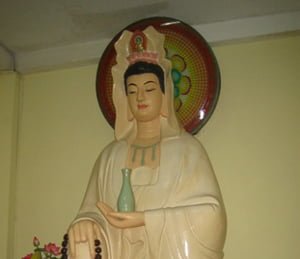
Outside there is a famous, and enormous, statue of Kuan Yin, the Bodhisattva of Mercy (Quan The Am in Vietnamese). It is a very popular object of worship, and throughout the day people come into the monastery grounds to make their own prayers at its base.


Statue of Quan The Am, Bodhisattva of mercy

The temple was built in the 60s, and visiting recently with an architect I was informed that it was a classic piece of American-era architecture, especially in its liberal use of pebble-crete. The main hall is built in the octagonal shape of all Tinh Xas, symbolising the Noble Eightfold Path of the Buddha. Over the years the surrounding buildings have been demolished and rebuilt, and I fear that the same fate awaits the main hall, which would be a shame.

Tinh Xa Trung Tam in Binh Thanh claims to be the main temple of the order, but it's worth mentioning that the order did break up into different sects in the 60s and there are a couple of other Tinh Xas around that claim to be Trung Tam (The Central). 

Just outside the main gates of the temple is a little bookshop, and a small gift stall next to it. The bookshop is run by the loveliest man, though sadly there are no books in English. If you have any Buddhist friends in Vietnam, though, or plan to make some, this is a great place to buy gifts. Publishing in Vietnam is vibrant, and books are beautifully designed and cheap. I always buy a bag-full and manage to distribute them easily.

You can find the temple at:

7 Nguyễn Trung Trực Street, Bình Thạnh District, Ho Chi Minh City.

It is about a 25 minute taxi ride from downtown Saigon (outside of peak hours) and is well worth a visit.
It is hidden down several lanes, so be prepared for your driver to stop and ask for directions along the way.

 In October/November this year I am once again leading a tour of Vietnam, from Hanoi all the way down to the Mekong Delta. This will be a fantastic journey, and I'd love to have you along.

Sunday, August 5, 2012

Monastery Gardens - Ho Chi Minh City - Chua Pho Quang


Pho Quang is a large-ish suburban temple in Ho Chi Minh City's Tan Binh district. When I first started coming to Vietnam it was situated in a semi-industrial area, surrounded by army and air-force camps. Now it is a densely populated urban zone, and the temple is actually quite hard to find, hidden away down several sub-streets.
It has one of the most fantastic Buddhist supply shops in Vietnam, and is well worth visiting for that reason alone. The products are very reasonably priced, and clearly ticketed, so it makes shopping a breeze.
The grounds are still quite spacious, and there are plenty of seats in the monastery courtyards, so it is a great place to spend an afternoon relaxing and people watching.


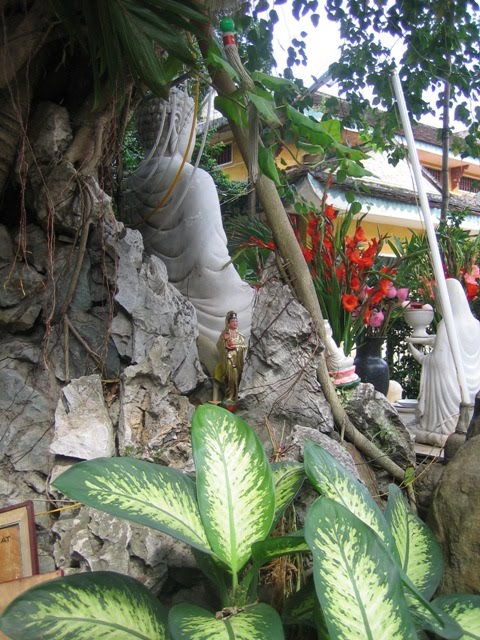
There are any number of shrines and grottoes in the temple complex, and on sabbath days the place becomes quite crowded. It is not really a place to come for Buddhist meditation, though in the Kwan Yin grotto quite a number of people attempt it, doing their best to block out the crowds and the chatter.
The common areas were all paved long ago, so the garden, such as it is, is composed of potted trees, shrubs and bonsai.


In the roots of the big trees that surround the outdoor shrines you can see a range of fascinating cast-off ritual objects.


Buddhists believe that you cannot throw away a statue or picture that you used in worship, so when such things break or get too tatty, the faithful bring them to temples like this one and put the unwanted items at the base of the temple trees, this being seen as a sufficiently respectful way of getting rid of them. I assume that a couple of times a year the temple just rounds all this junk up and throws it out - I have never enquired about the actual ritual requirements of it all. It would be fascinating to know.

Friday, October 14, 2011

Spirit Shrines


The spirit is ever-present in Vietnam – even on street corners in sophisticated downtown Saigon you will come across these small shrines dedicated to the wandering ghosts and the spirits of place.

These shrines are actively tended by people in the community who offer fruit and incense every day.

This is a humble example from Tan Binh District in suburban Ho Chi Minh City. In the countryside, especially in central Vietnam, the spirit houses become larger, more colourful and elaborate.

This speaks to an ancient animist tradition that still holds great sway in Vietnam.

Streets and suburbs are possessed of their own protective spirits, but even more so are mountains, old trees and waterfalls.

Wednesday, October 27, 2010

Shrine to the Monastic Ancestors - Phap Bao Temple - Sydney


In most Vietnamese Buddhist temples there is a shrine to the monastic ancestors. Normally situated directly behind the main shrine, or in an ante-chamber, these are shrines dedicated to the elder monks and nuns whose lineage the temple monks now represent. Commonly, most of these shrines will contain an image of Bodhidharma, who most Vietnamese Mahayana monks consider their common ancestor. It is also not uncommon to find a photograph of the revered Vietnamese Buddhist Martyr Thich Quang Duc, whose example continues to inspire the Buddhist clergy across every shade of the political spectrum.


These are some images from the Shrine to Monastic Ancestors at Phap Bao Temple near Cabramatta. To find this shrine you have to duck beneath the large statue of the Buddha in the main hall.
The photographs, paintings and calligraphed names of the Patriarchs are quite touching, and I often wonder if anyone at the temple really knows who they all are. I suppose someone must know, in order to have been able to assemble the shrine in the first place.
When a monk joins the religious life he leaves his birth family and joins instead the new family of the Buddha. He abandons all of his old names and takes on the name "Thich" - the first part of Sakyamuni Buddha's name in Vietnamese. And, just as he would have offered prayers and memorials to an ancestor shrine at a private home (and just about every home has one in Vietnam), so he switches his affiliation to this new set of mysterious ancestors, the men (or women, if it is a nun) who represent that particular Buddhist lineage.
It is a rich and fascinating area, and one which I'd like to study more, though I always find it awkward to ask specific questions about the people on the shrines - it seems kind of crass.
Related Posts with Thumbnails