Showing posts with label Vietnamese Buddhism. Show all posts

Thursday, November 22, 2012

Minh Dang Quang


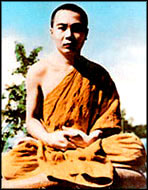
One of the most mysterious and fascinating figures in Vietnamese Buddhist history is the Patriarch Minh Dang Quang.


Though he was an enormously influential character whose legacy still thrives today in Vietnam, there is almost nothing about him in English. If there is something substantial I'd be most grateful if anyone could alert me to it. I have discovered an excellent scholarly article by Mark W. Mcleod called 'The Way of the Mendicants' which provides some excellent insights into life at Tinh Xa Trung Tam, the central monastic institution for the sect.


Minh Dang Quang was the founder of the Tang Gia Khat Si (The Mendicant Buddhist Order) - this is one of the largest Buddhist sects in Vietnam, and the Khat Si temples (known as Tinh Xa) are to be found all over Southern Vietnam (including many in Ho Chi Minh City). He was half Viet half Khmer, from Vinh Long province, and his bi-racial upbringing exposed him to both Mahayana and Theravada Buddhism. At a young age he was driven by the idea of combining the two traditions in Vietnam, the only country that could boast of sizeable numbers in each camp.

So he established the Mendicant Order, and it quickly gained in popularity, particularly in the villages and towns of the Mekong Delta. Minh Dang Quang was impressed by the strictness of the Theravadin monastic orders, and so created similar rules for his own monastics - banning the consumption of food after midday, banning the use of shoes or sandals, not allowing monks to cook or prepare their own food, encouraging them to go on begging rounds in the morning etc. He also added the additional burden of vegetarianism, which is not normally observed by Theravadin monks. He opened up the monastic vocation to women, another tradition also absent in the Theravada.

Adopting the theological structure of Mahayana almost holus bolus, he encouraged both the recitation of Amitabha Buddha's name and the worship of Kwan Yin, both of which are anathema to the Theravadin establishment.

What really popularised his movement however - aside from the great respect the people formed for the monks and nuns willing to observe such hardship - was his translation of the Buddhist sutras from the difficult (and sometimes even nonsensical) sino-vietnamese language into an easily understood and even rhyming form of the common language. The largely uneducated parishioners found it infinitely easier to remember these sutras, and to glean some meaning from them. This, naturally, made him extremely unpopular with the Mahayana Buddhist hierarchy, who accused him of corrupting the Dharma by tampering with the texts they had known since antiquity.

Sometime in the 1950s Minh Dang Quang 'disappeared' and was never seen again. There were rumours that he was assasinated by the anti-Buddhist government forces who saw him as a trouble-maker, or by agents of a rival Buddhist sect who saw his growing movement as a threat to their own power base in the Mekong Delta. His followers, however, refuse to acknowledge his death and still celebrate his 'disappearance' day each year.

An intriguing character with an intriguing story - one day I think I will write a book about him.

Friday, August 17, 2012

Monastic Communities


Buddhist monastic communities are still very much alive in Vietnam, though the numbers of young monks have dwindled rapidly from their heyday twenty years ago when Vietnam was desperately poor and entering a monastic institution was seen as a guarantee of a comfortable and predictable life. Now that Vietnam has well and truly entered the consumer age young people are less willing to embrace a life of renunciation, celibacy and physical hardship in exchange for predictable food and quality education. 


The Baby Buddha, Tinh Xa Trung Tam, Ho Chi Minh City


And because the predominant form of Buddhism in Vietnam is Mahayana, there is none of the temporary ordination that you see in neighbouring countries like Cambodia and Laos, which swells the ranks of monks quite deceptively with young men and makes for all those charming pictures of monks that people take back home after their holidays. 


Monk blessing people, Battambang, Cambodia


In the Vietnamese tradition you take the monks’ robes for life, so young men take the decision a good deal more seriously. 


The internet has been abuzz for the past week or so with stories of a gang of Buddhist monks in Korea caught on camera drinking, smoking and gambling. It would be extremely naive to think that such things don’t go on in Vietnam. Of course they do. Drinking is completely verboten, but back in the 90s I knew young monks who consumed beer at parties. When I questioned them about this, they maintained that the ban was on strong forms of liquor like vodka and whiskey. Beer, they maintained, was only a mild intoxicant and so not technically wrong. Absolute nonsense, of course, but it was a common deception. 


In the 80s and 90s I would say that most monks in Vietnam smoked, though I have noticed that in recent years this is increasingly frowned upon, and many of my old monastic companions have given up for the sake of propriety. The disapproval of lay people had simply grown too strong. I can honestly say I have never witnessed monks gambling. I think that gambling is such a real and ever-present social problem in Vietnam, one which regularly destroyed the lives of the people they ministered to, that they were not capable of giving it any kind of saffron-wash. 


One sees now, more and more often, clips of Buddhist monks on Youtube doing inappropriate things, like dancing, staring down women’s blouses or even, in the case of one Thai monk, vouging. Of course, these things are all forbidden by the Vinaya, the enormous code of ethical conduct for monks devised by the Buddha many centuries ago.  This is a fascinating document, going into the detail t hat it does about what monks should or shouldn’t do. The list is exhaustive and seemingly random – most scholars assume it was created in reaction to infringements by monks living in the Buddha’s day, or the complaints of scandalised lay people. 

And so it is that rules exist forbidding monks, for example, to climb trees, or to roll rice up in balls and throw it into their mouths, or to eat with an “mmmph mmmph” sound. So extensive is the list of forbidden activities in the Vinaya that it is almost impossible for any human being to uphold them all, and most monks don’t even try. The Buddha himself knew this, and said that if a monk could abide consistently by every rule established he would be immediately enlightened. Suffice to say that enlightenment among monks is still pretty thin on the ground.

Wednesday, June 6, 2012

States of Rebirth

Today I was wandering through the streets of Cabramatta when I spied, in a big pile on a shelf of free Buddhist literature outside a vegetarian supermarket, this laminated leaflet:


It transported me instantly back to Vietnam, where this particular poster is very commonly encountered, particularly in the guest rooms at temples and on the walls of vegetarian restaurants.
It is a chart of the various states of rebirth we might hope to attain.
Now of course, some of those staes of rebirth are in hell, where the wicked must pay for their torments.
This used to be a decorative motif much beloved of Buddhist temples, though it seems to have become unfashionable in recent years, and many temples have painted over their vivid wall murals depicting the various torments of hell.
I found some intact, however, at the Vietnamese Buddhist temple in Phnom Penh.


And while in Siem Reap I visited the truly ghastly Cambodian Culture Village, where the only thing even mildly amusing was the "Tunnel of Judgement" featuring 3D renderings of the punishments infliced on the evil in the hell realms.
These dioramas were a kind of torture porn, and of all the photos I took this is the ony one I can show safely on a PG rated blog:

Tuesday, September 27, 2011

Sakyamuni Buddhist Centre, Canberra


Di Lac Phat (Maitreya Buddha), Sakyamuni Buddhist Centre, Lyneham, Canberra


I was in Canberra last week and dropped by the Sakyamuni Buddhist Centre, Canberra's largest Buddhist temple (and getting bigger). The abbott there is the Venerable Thich Quang Ba, one of Australia's senior Buddhist monastics, and a revered figure in the overseas Vietnamese community. Thich Quang Ba hails from Binh Dinh province in Central Vietnam, a place I write about a lot in my book about Vietnam, Destination Saigon.


If you ever travel to Vietnam, Binh Dinh is well worth visiting - well off the usual tourist track, it is a beautiful little spot, and filled with a rich religious history.


Quan The Am (Bodhisattva of Compassion), Sakyamuni Buddhist Centre, Canberra


Sakyamuni Buddhist Centre was established in Canberra in the early 80s, and at the moment is undergoing extensive renovation and re-building. When it's all finished it will look amazing. But just at the moment it is a building site and that's about it.


Model of Chua Mot Cot (One Pillar Pagoda), Kwan Yin Pond, Sakyamuni Buddhist Centre

Friday, August 12, 2011

Sunday, January 16, 2011

Wat U Phai Rat Bamrung - A Vietnamese Temple in Bangkok!


For many years I'd heard of a mythical Vietnamese Mahayana Buddhist temple in the heart of Bangkok, but whenever I visited Thailand my Thai friends had never heard of it and assured me that no such place existed. My Vietnamese friends who had visited it were shaky in their grasp of Bangkok's topography, and couldn't give any useful directions.
One day I was wandering around Pantip Plaza and I saw two young monks shopping. Though they were dressed peculiarly (see my description in the video) I knew instantly that they were from the Mahayana school - a rare sight in Thailand. Using my minimal Thai and their even more minimal English I managed to get their address and visited them that day. Lo and behold, I had discovered my long sought for Vietnamese temple.
Most Bangkokians, even those living in the Chinatown district, have no idea that Wat U Phai Rat Bamrung on Charoen Krung Rd was established by a Vietnamese monk 300 years ago. They have just glanced inside and assumed it was one of the various Chinese temples that dot this part of Bangkok.
The families that make up the temple's devotees were once Vietnamese, but were long ago assimilated into Thai culture. All that remains of their ethnicity is their allegiance to this strange temple. The chanting is done in Vietnamese, but the parishioners (and the Thai monks resident) need to read the words transliterated into the Thai alphabet.
I have blogged some photos of the temple in the past.
There are two young monks from Vietnam resident, and they are rather unstinting in their continued Vietnamese-ness. They refuse to eat meat and they assume a rather more active role in the community than Thai Buddhists are used to.
It is a strange place, and one that I like very much. As soon as I get to Bangkok I always try to visit, and my Thai friends are always fascinated to learn about it. I guess it is a remnant of a much closer relationship that once existed between the two countries.

Friday, January 7, 2011

My Guide to Vietnam: Interacting With Buddhist Monks and Nuns

Most visitors to Vietnam will encounter monks and nuns.

Buddhist temples make up a big part of the itinerary for any visitor to Vietnam, and almost all of these places are living, thriving monastic communities.


You will witness monks and nuns wandering about attending to their duties, and for most they remain mysterious, exotic and ever-so-slightly glamorous figures.


Any reader of Destination Saigon will know that Buddhist monks and nuns are a big part of my world, both in Vietnam and Australia, and have been so for many years.


People often ask me how they should behave in the presence of monastics, so here is a bit of advice.
Whenever you encounter monks or nuns you should greet them in the traditional Buddhist manner, with your hands clasped in the "prayer" position, at the chest.


In Vietnamese this is called chap tay, and it is a lovely tradition that is steeped in symbolic meaning. Thich Nhat Hanh writes about it, comparing the clasped hands to a lotus bud. By placing our hands together at our chest and bowing slightly (no need to over-do it), we are honouring and respecting the other person - Thich Nhat Hanh says the Buddha in me is greeting the Buddha in you, or "a lotus to you, a Buddha-to-be." Monks greet each other in a similar fashion, as do lay-people when they are at temple. In Vietnam the chap tay is reasonably uncomplicated - you simply make the gesture at chest level, no matter who you are or who you are meeting. In other South-East Asian countries it is altogether more tricky, and you have to raise your hands to different levels depending on what you are doing and who you are encountering. I invariably do it wrong. To make matters worse, the conventions are ever-so-slightly different in Thailand, Laos and Cambodia, so that what was ok in one place becomes a gaffe in another.
When Buddhists make the chap tay gesture they also normally say Mo Phat, which is an abbreviated version of the mantra Nam Mo A Di Da Phat, which means "Hail Amitabha Buddha." If you can master these two actions, you will be an instant member of the Buddhist community in Vietnam!
If you see monks or nuns, do smile at them and greet them – most foreigners ignore them - mostly because they they are shy, I suspect, or worried that they may say or do something wrong. Perhaps they are also concerned that a monk is not to be bothered with foolish tourists and everyday gestures. But believe me, they love it when someone is friendly towards them
, especially a foreigner. Monks and nuns in Vietnam are frequently well educated and can sometimes speak good English, so do try to connect.

Of course, there are a couple of simple dos and donts when it comes to interacting with them:

  • Avoid physical contact, especially if they are of the opposite sex.
  • Dress respectfully, especially if they invite you to a special event - this goes for men and women - no shorts and only shirts with sleeves.
  • Be careful of violent acts - most monastics in Vietnam are strict vegetarians, and things like swatting at mosquitoes and squashing ants, which we do instinctively, can actually upset them.
  • Don't visit the temple if you have been drinking.
  • Don't arrange meetings at cafes, hotels, shopping centres or other places of secular entertainment - generally their vows don't allow them to go to such places. You can meet at temples, bookshops and vegetarian restaurants instead.
  • Don't give them tasks or errands, or ask them to pass on messages or gifts. Their vows actually forbid this.
  • Offer them money, by all means, but do it discreetly - always put the money in an envelope. It also helps them if you tell them what the money is for e.g. "This is for you" or "This is for the temple." Generally they are bound to use the money in the way the lay-person intends, so make it easy for them. If they refuse a monetary gift, you can always insist and say it's for the temple, or for charity, in which case they must accept. What do nuns and monks need money for? I hear you ask. Well, books, study-fees, transport, food - most rely entirely on private sponsors just to survive, so your gifts will always be needed. If you ask them what they want, please be clear about the amount you want to spend, as this saves awkward situations. If you are ofering to buy them $30 worth of books, say so, so they will know not to ask for $10,000 for a temple extension. This might seem all very mundane and worldly, but it is, in fact, the kind of thing that local lay-people do in their own interactions with the religious.
  • If you see a monk or nun in a bookstore, offer to pay for their purchase. You can also do this in a vegetarian restaurant. If they are already in the company of lay-people, however, it's probably best not to do this, as they are probably already being looked after, and you don't want to embarrass anyone.
  • Gifts for monastics: apart from cash, you can offer tea (especially imported), live plants (esp. orchids), cut flowers, fruit, books (they love Buddhist books in English), stationery, Buddhist religious images and paraphernalia (especially from other countries), incense (expensive or imported only), candy and cartons of soft-drink or vegetarian packet noodles.

Saturday, November 13, 2010

Vietnamese Kitsch: Lacquered Religious Pictures


When I first visited Vietnam in the mid 90s, lacquerware was just about the only handicraft item available. It was sold everywhere and lacquer factories were ubiquitous. These were Dickensian institutions, with small, thin boys, their hands and arms blackened with lacquer, toiling away in hot warehouses with sad faces. It was an old-fashioned, labour-intensive process.
Ten years later Vietnamese lacquerware became ubiquitous - not the traditional black stuff with inlaid gold and mother-of-pearl in traditional designs, but groovy rice bowls, trays and jewellery boxes. You could buy them anywhere, from Newtown to Nanjing. Indeed, even now when you go shopping for handicrafts in China a great many of the items available come from Vietnam.
Last time I was in Vietnam, however, lacquer seemed to be distinctly out of fashion. The brighly coloured, more modern items were still in evidence,but the traditional boxes and paintings had almost entirely disappeared.
What had cropped up instead were lacquered religious pictures, available very cheaply at temple and church gift shops. I bought this wonderful image of Di Lac Phat (Maitreya Buddha) at Phap Hoa Temple, and I used to hang it in my office. My friends at work called it "The Gay Buddha" - and I can kind of see what they meant.
I am a sucker for this kind of thing - I love religious imagery at the best of times - the more gaudy, the better.

Wednesday, November 10, 2010

Nuns Chopping Firewood, Ho Chi Minh City


I found this beautiful old photo that I took back in 1996.
I don't remember where this particular nunnery was, but it was somewhere in the suburbs of Ho Chi Minh City. It was in a side street, and by chance I was riding past in a cyclo and I got the driver to stop so I could check out the temple. When I peered in through the closed gate I saw the nuns hard at work chopping firewood. One of them let me in to the courtyard, and they all giggled as I photographed them at their hard, hot work. One of the sisters put on a proper outer robe and took me into the prayer hall so I could pay my respects to the Buddha.
In Destination Saigon I write about this industriousness much in evidence in nunneries in Vietnam. Traditionally, women's communities have attracted less lay support than men's, and so the nuns have always relied on some form of industry to keep their temples going. The chopping and selling of firewood is quite unusual work - though I do know of a men's community in Phu Nhuan who have a full-scale lumberyard in operation! Nunneries more typically manufacture incense, produce vegetarian delicacies for re-sale, make rosaries, sew religious clothing, produce and copy Buddhist CDs and DVDs and operate vegetarian restaurants. Ironically, this has seen women's communities grow prosperous, particularly in the bigger cities.

Saturday, November 6, 2010

Tinh Xa Ngoc Huong - Hue


One of my favourite places in Hue is the sleepy and little-visited monastery in the Old City called Tinh Xa Ngoc Huong.


It is situated on an island, and legend has it that this was once the site of the emperor's library. I'm not sure how it came to be held by the Tang Gia Khat Si, the indigenous mendicant Buddhist order, but they still have it, and the only way to get to it is via a long, narrow cement bridge over a lake. The monastery sits all on its own on the little island in the middle, quite decrepit and rarely attended.


It's a glorious little piece of old Vietnam.
I have something of an histoire with the temple. Back in 1996 I was a devout young Buddhist travelling Vietnam in the company of an eccentric Australian-Vietnamese monk who had recently ordained in the order. You must understand that the Khat Si, the indigenous Buddhist order, is still very much a religious minority in Vietnam, and is looked down upon by those who are part of the more established Mahayana mainstream. The little monastery in Hue represented at that time the order's northernmost outpost, and I'm sorry to report it wasn't doing well. It was run by an exceedingly curmudgeonly old monk who terrorised the younger monks, the temple staff and any lay-person brave enough to visit.
I had been instructed to go to the temple and stay for a while, and as soon as I arrived the old monk turned me into his personal ATM and part-time slave. I had to take him to the dentist (and pay for it), go shopping at the market for better quality food than they were used to (the temple was terribly poor), hang around all day for prayer sessions (which were often cancelled because they were all so lazy), and fend off the troops of beggars who would come scooting over the footbridge when they heard there was a foreigner there.
On days when the old monk's teeth were hurting (and he did suffer terribly, the poor old fellow) a big roll of razor wire would be tossed across the footbridge and nobody would be allowed in or out. We would skulk quietly around the damp, filthy temple and wait for the mealtimes. The temple employed a single servant, a rough-voiced, sullen midget whose gender was completely impossible to guess. After a couple of weeks I still had no idea. This poor person was screamed at, berated and occasionally hit by the old monk in his fury at various incomprehensible offences.
Apart from beggars, no-one at all came for prayer services. The good Buddhists of Hue were largely orthodox in their observance, and had no interest in the strange little cult occupying such a picturesque location. Oddly, an order of nuns belonging to the same sect lived a block away, and the good sisters kept a ship-shape temple. They made incense which they sold all over the country, and their prayer hall was gleaming and constantly being renovated and enlarged. Ours was literally rotting away, and parts were quite dangerous. The monks refused to engage in any type of commerce because the strict rules of the Order forbade it. So they festered in the most miserable poverty, relying on the kindness of the nuns who would advance them money occasionally.
When I was last in Hue I visited the Tinh Xa once again, and was surprised to see that a number of changes had been made. The place was looking positively respectable. The old footbridge had been replaced with a much wider and sturdier model.


The buildings had all been re-rendered and freshly painted.


Still, the whole place was locked up, and the only monk I saw was someone I didn't recognise.
I thought of dropping by the monks' quarters and asking after the old man, but I was with friends, and they were spooked by the place. "Why on earth would you want to come visiting a damp old dump like this?" asked my Vietnamese friend, clearly unimpressed by the romantic surroundings.
The prayer hall was locked, so I stood outside and peered in at the statue of the Patriarch and said a quick, perfunctory prayer. I remembered the old monk's teeth, the poor midget who cooked the dreadful meals, and the lines of sad beggars and neer-do-wells who would visit me day after day with their sad stories.
I blessed them all, and I went back to my hotel.

Details:

Tinh Xa Ngoc Huong
Le Van Huu St
Old City, Hue, Vietnam

Wednesday, October 27, 2010

Shrine to the Monastic Ancestors - Phap Bao Temple - Sydney


In most Vietnamese Buddhist temples there is a shrine to the monastic ancestors. Normally situated directly behind the main shrine, or in an ante-chamber, these are shrines dedicated to the elder monks and nuns whose lineage the temple monks now represent. Commonly, most of these shrines will contain an image of Bodhidharma, who most Vietnamese Mahayana monks consider their common ancestor. It is also not uncommon to find a photograph of the revered Vietnamese Buddhist Martyr Thich Quang Duc, whose example continues to inspire the Buddhist clergy across every shade of the political spectrum.


These are some images from the Shrine to Monastic Ancestors at Phap Bao Temple near Cabramatta. To find this shrine you have to duck beneath the large statue of the Buddha in the main hall.
The photographs, paintings and calligraphed names of the Patriarchs are quite touching, and I often wonder if anyone at the temple really knows who they all are. I suppose someone must know, in order to have been able to assemble the shrine in the first place.
When a monk joins the religious life he leaves his birth family and joins instead the new family of the Buddha. He abandons all of his old names and takes on the name "Thich" - the first part of Sakyamuni Buddha's name in Vietnamese. And, just as he would have offered prayers and memorials to an ancestor shrine at a private home (and just about every home has one in Vietnam), so he switches his affiliation to this new set of mysterious ancestors, the men (or women, if it is a nun) who represent that particular Buddhist lineage.
It is a rich and fascinating area, and one which I'd like to study more, though I always find it awkward to ask specific questions about the people on the shrines - it seems kind of crass.
Related Posts with Thumbnails