Showing posts with label Quan Am. Show all posts

Wednesday, February 17, 2016

Tinh Xa Trung Tam, Binh Thanh District, Ho Chi Minh City


Tinh Xa Trung Tam has a special place in my heart because it is the first temple in Vietnam that I ever had any real connection with. In the mid-90s I was a student of a monk in Australia who was a part of the order, and so I visited Vietnam with the special intention of studying more here and learning about this distinctive form of Vietnamese Buddhism.


Master Minh Dang Quang

Tinh Xa Trung Tam is one of the centres of worship for the Tang Gia Khat Si, an indigenous Buddhist order founded by Master Minh Dang Quang. There is an excellent Wikipedia entry for this temple which explains its history and a little about the Order and its founder (I would actually love to hear from whoever wrote it) which you should read.

I have spent many days in this temple and its surrounds, though these days when I go back to Vietnam I probably only visit once or twice to say a prayer and soak in some of the memories of my youth.

I am still quite fascinated by the Order's founder, a Mekong Delta monk called Minh Dang Quang who attempted to unify the Theravada and Mahayana schools of Buddhism and re-write the scriptures in colloquial Vietnamese. As at every Tinh Xa (the Vietnamese version of "Vihara" which is what the Tang Gia Khat Si temples are called, as opposed to the Mahayana temples which are called Chua in Vietnamese), there is a shrine to the Master, and this one also contains some of his relics.


Shrine to Master Minh Dang Quang, his relics in cabinet below

On a weekday afternoon there is rarely anyone inside the main shrine, and it is a great place to sit quietly and meditate, or to do a round or two of quiet recitation of the Buddha's name.

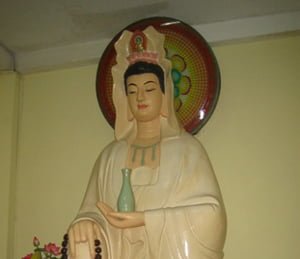
Outside there is a famous, and enormous, statue of Kuan Yin, the Bodhisattva of Mercy (Quan The Am in Vietnamese). It is a very popular object of worship, and throughout the day people come into the monastery grounds to make their own prayers at its base.


Statue of Quan The Am, Bodhisattva of mercy

The temple was built in the 60s, and visiting recently with an architect I was informed that it was a classic piece of American-era architecture, especially in its liberal use of pebble-crete. The main hall is built in the octagonal shape of all Tinh Xas, symbolising the Noble Eightfold Path of the Buddha. Over the years the surrounding buildings have been demolished and rebuilt, and I fear that the same fate awaits the main hall, which would be a shame.

Tinh Xa Trung Tam in Binh Thanh claims to be the main temple of the order, but it's worth mentioning that the order did break up into different sects in the 60s and there are a couple of other Tinh Xas around that claim to be Trung Tam (The Central). 

Just outside the main gates of the temple is a little bookshop, and a small gift stall next to it. The bookshop is run by the loveliest man, though sadly there are no books in English. If you have any Buddhist friends in Vietnam, though, or plan to make some, this is a great place to buy gifts. Publishing in Vietnam is vibrant, and books are beautifully designed and cheap. I always buy a bag-full and manage to distribute them easily.

You can find the temple at:

7 Nguyễn Trung Trực Street, Bình Thạnh District, Ho Chi Minh City.

It is about a 25 minute taxi ride from downtown Saigon (outside of peak hours) and is well worth a visit.
It is hidden down several lanes, so be prepared for your driver to stop and ask for directions along the way.

 In October/November this year I am once again leading a tour of Vietnam, from Hanoi all the way down to the Mekong Delta. This will be a fantastic journey, and I'd love to have you along.

Monday, April 28, 2014

Quan Am Pagoda, Phu Nhuan


One of the places I find myself constantly recommending people visit is the little-known Quan Am Pagoda in Phu Nhuan District, Ho Chi Minh City.


This temple is also mentioned in my book, Destination Saigon, and I have been visiting there for almost 15 years now.


It is a pretty basic suburban temple, but it was the Saigon residence of Thich Quang Duc, and as I mentioned in a previous post, it has become something of a shrine to him.
Downstairs is a large shrine to Thich Quang Duc Bodhisattva and the other Buddhist martyrs that followed him - most people don't realise that many people, both monastic and lay, followed his example and set fire to themselves in protest to the war.


There is also a large and very kitsch grotto housing a quite unique shrine to Quan Am (Kwan Yin). This particular shrine is very popular with locals, and the statue of Quan Am is quite unique, in a form rarely seen.


To get to the grotto you need to walk through the gift shop to the left of the temple, and then climb up through the fake cave. Offerings are made from behind the statue. This grotto is exceedingly cramped, and should you meet someone on your way up or down one of you is going have to re-trace your steps - it is almost impossible to pass another person.

Details: Chua Quan Am - Phu Nhuan, 90 Thích Quảng Đức St, Phu Nhuan, Ho Chi Minh City

Wednesday, December 19, 2012

Top 5 Day-Glo Lotuses in Vietnam

I have a thing for the popular Buddhist art of Vietnam.
I am a fan of the school of maximilism that informs most of the temple decoration that you see in Vietnam. Indeed, the working title for my book Destination Saigon was 'Day-Glo Lotus and Neon Halo', which I thought captured perfectly the kind of Vietnamese groove I wanted to describe. Sadly, my publishers didn't agree.
So I wanted to present you with a less-than-comprehensive overview of some of Vietnam's finest day-glo lotuses.


  1. An Long Temple, near Quy Nhon, Binh Dinh Province: This is the classic in contemporaray day-glo lotus sculpture. Supporting a colourful statue of Di Lac, the fat, laughing Buddha of the future, this lotus is the hottest of pinks, with the acidest of green contrasts. These kinds of statues are still produced by hand at little workshops all over Vietnam. Made of plaster, they are quite fragile but still remarkably heavy. They are also quite cheap.


2. Hien Nam Temple, Quy Nhon City, Binh Dinh Province: Right near Quy Nhon's massive supermarket sits this more subtle example of an outdoor lotus. Rendered in a faded orange, these outdoor lotuses have to be touched up yearly, and so can undergo quite radical changes in colour from one year to the next. This one is supporting Quan The Am, the Bodhisattva of Mercy.


3. Khanh Hoa Temple, Pham Van Hai St., Tan Binh Dist., Ho Chi Minh City: This is vintage lotus, pre-1975. Much more beautifully and carefully rendered, I'd say constructed on the spot from reinforced cement. This is the largest of the lotuses featured. It is an indoor setting, and the colours are slightly more muted.


4. Giac Vien Temple, Dist. 11, Ho Chi Minh City: This temple is filled with antique wooden statues of great beauty, but these are a couple of the newer additions. The statue in green is quite a unique rendering - I've never seen a deity dressed in quite that shade in any other Vietnamese temple. Her position next to Amitabha makes me think it is a statue of Dai The Chi (Mahasthamaprapta) but I can't be sure, because the iconography is stangely noncommittal.


5. Huong Mai Temple, Hoai Nhon village, Binh Dinh: This is a detail from quite an amazing outdoor statue of Quan The Am at a remote fishing village. The red lotus column emerges from the belly of a dragon painted a quite distinct shade of aqua. This colour is new in temple statues, but I noticed it being used a lot in Central Vietnam last time I was there. I love how even these things are influenced by fashion!

Saturday, May 8, 2010

Quan The Am Bo Tat


One of the most common objects of popular devotion in Vietnam is this woman – Quan The Am, the Buddhist Goddess of Mercy.


In the West she is more commonly known by her Chinese name, Kwan Yin. Shrines to her are to be found everywhere in Vietnam, in people’s houses, on streetsides, in temples.


She embodies the qualities of compassion and unconditional love. Vietnam’s culture has a great reverence for the mother, and people indulge in a great deal of devotion directed toward this idea of the Divine Mother – one of her appellations is Me Hien, the Gentle Mother.


I love this idea of the sacred feminine, and it is one of the aspects of Vietnamese spirituality that draws me constantly back.


I grew up a Protestant boy in rural North Queensland, and reverence for the Holy Mother was not something I had ever encountered in my past.

Saturday, April 24, 2010

Two Qualities - Hope and Compassion


I love this photograph, which was taken at my friend's temple in Binh Dinh.
Quan The Am (Kwan Yin), the Bodhisattva of Compassion, stands on the lower terrace, and Di Lac Phat, the Buddha of the Future, stands on the upper terrace above her.
For me it represents two important qualities, qualities which my friends in Vietnam always seem to embody: Compassion and Hope.
Quan Am is the Gentle Mother, the Hearer of the Cries of the World - she can always be turned to in moments of frustration, of betrayal, of confused feelings and pain.
Above her is Di Lac (Maitreya), fat and laughing, representative of a hopeful future, a time of plenty. He always stands in a prominent place in Vietnamese temples, reminding us to retain our own lightness and sense of fun in the face of the often considerable sufferings of this world.
Related Posts with Thumbnails