Showing posts with label Buddhas. Show all posts

Tuesday, March 20, 2012

A Vietnamese Temple in Phnom Penh


There was once a large Vietnamese population in Phnom Penh.
When I first visited in 1996 I heard Vietnamese spoken often on the streets. Restaurant owners, cafe proprietors, market-stall holders - all were frequently Vietnamese. The city boasted several Vietnamese Mahayana temples with resident monks, as did outlying areas.
This has been gradually changing. More and more Vietnamese return home, despite having lived in Cambodia for a generation. The Vietnamese temple close to Olympic Market is the last one I know of in the inner-city area, and that seems to be on its last legs. Of course, no-one knows where it is, and most Tuk-tuk and moto drivers will tell you that there is no Vietnamese Wat in Phnom Penh. The only one they know of is in a fishing village about 15 kilometres outside of the city. I knew it was there somewhere, though, and eventually I went out to the Vietnamese restaurant next to the Mai Linh bus stop that sells tickets to Ho Chi Minh City. The kindly owner affirmed there was a Vietnamese temple nearby, and the waiter drove me there on the back of his bike, having stopped to ask directions several times.


When I visited last year there was still a resident monk, albeit a very grumpy and not particularly outgoing one. But even he has left, leaving the temple more or less deserted. The temple-keeper seems to be an 18 year-old boy, helped by some of the surrounding families and kept company by a shifting cast of ne'er-do-wells that sleep in hammocks in the prayer hall.
It's a shame, because it is a beautiful little place, displaying a unique amalgamation of the two religious styles. The usual wall murals common in Theravadin temples across Southeast Asia are here, but with the addendum of murals depicting Mahayana concepts of hell and the cultivation of merit that one might see at a Chinese or Vietnamese temple.
The main shrine contains the usual Vietnamese mix of Buddhas and Bodhisattvas, but also a Khmer-style image of the Buddha that you would never encounter in Vietnam.


Outside the temple are a number of small shrines, including one devoted to a local Goddess from Ca Mau in Southern Vietnam - I have never encountered her before.


The temple is well worth a visit, though prepare for a struggle to find it. It is actually centrally located - it's just that no-one knows about it.


Ask the driver to take you to Wat S'nyay (Wat Vietnam).
He may not know where it is, in which case ask him to take you to Street #134 and ask directions from there.

Friday, August 12, 2011

Sunday, July 17, 2011

Medicine Buddha


Though much more an important deity in Vajrayana Buddhism, the Medicine Buddha is also sometimes invoked in Vietnamese Mahayana Buddhism. In Vietnamese he is called Duoc Su.

Monday, September 20, 2010

Books at Buddhist Temples


One of my more esoteric interests is in the literature left for free distribution at Buddhist temples. So great is this interest that I very nearly did my Honours Thesis on it - until common sense intervened.
At almost every Buddhist temple you will find a crowded, untidy shelf or two of free literature. The distribution of religious literature and images is a very old part of Buddhist culture. To print such material and distribute it is seen as one of the best ways of cultivating good karma.
In Thailand families will frequently print a religious book in memory of a recently deceased relative and distribute the book at the funeral, and then at temples afterwards. If you've travelled to Hong Kong or Taiwan you will know that these free books and pictures are seen everywhere. Indeed, the epicentre of freely distributed Buddhist material seems to be Taiwan, and it is the source of most free Buddhist material that you come across in Australia.
As well as books you also encounter small laminated cards featuring images of the Buddhas and Bodhisattvas and, less frequently, famous monks.


These days, too, it is common to see audio CDs and DVDs of chanting, Buddhist music and recorded Dharma talks.


Obviously this kind of media is much cheaper to produce than bound books, and it is also more accessible for older people, the less literate, or those who aren't inclined to read much.
Interestingly, the material left at temples is frequently non-exclusive, and not necessarily Buddhist. I came across this pamphlet dedicacted to the worship of the folk-God Guan Di, and a lot of the other material available is produced by Buddhist sects who aren't necessarily in philosophical agreement with the individual temple.


On occasion I even come across Christian literature, left there by hopeful missionaries!
Some temples even distribute small machines that contain a digital recording of a Buddhist chant.


You can switch these on and leave them going all day, thereby having your prayers said for you. The ones on offer at this temple chant Amitabha Buddha's, Kwan Yin's and Sakyamuni's name. In Vietnamese or Chinese - your choice!

Thursday, May 6, 2010

House Temples


People don't realise that Sydney is filled with little suburban house temples. There is well over a hundred of them, many of them in the Cabramatta/Fairfield area. They are simple suburban houses that have been renovated to become Buddhist temples, and they are the heart of many Buddhist communities.


Normally operating in a quasi-legal nowhere land, these little houses of worship are often at the mercy of local government authorities, who frequently fine them, threaten legal action and attempt to close them down. But in my experience they normally soldier on, and I find them wonderful examples of the power of the spirit standing up to the awful dead hand of homogenising local councils. It is normally the same councils that allow local "clubs" (i.e. pokie palaces) to swallow up whole tracts of land and alienate public property.


These temples normally only house one or two monastics, and service a membership of a dozen or so families. It is a hand-to-mouth existence for most, but the fact that so many monks and nuns are prepared to lead this lonely, uncomfortable and inconvenient existence in order to serve small communities stands as a testament to commitment and lived ideals.


Normally the house temples arise because parishioners - particularly the elderly - want a place of worship that is accesible by public transport. Almost all of the big Buddhist temples are in far-flung areas, quite often industrial or semi-rural districts, which are the only places they are normally allowed to build according to vile local government by-laws. Such places are almost impossible to access via public transport.


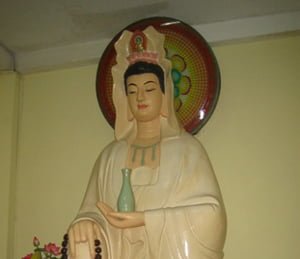
I love these little temples. My heart sings when I drive by a brick-veneer cottage and see a huge statue of Kwan Yin standing outside, sending her blessing out over the anonymous streets and cul de sacs of suburban Sydney. I know that people there still rate their spiritual life highly, and are supporting yet another humble, but terribly important, house temple.

Wednesday, March 24, 2010

Thich Ca Mau Ni Phat


In Vietnamese, Sakyamuni Buddha - the historical Buddha - is known as Thich Ca Mau Ni Phat. He is the principle figure in most temple shrines. I often wonder about this, as most Mahayana Buddhists in Vietnam have Amitabha and Kwan Yin as the central focus of their worship. And yet Sakyamuni remains as the central figure of physical reverence and the object of chanting and repentance.
Monastics take on the name Thich as their family name once they enter the monastery - Thich being the first part of Sakyamuni's name, thus signifying their leaving their earthly families and entering the family of the Buddha.
The naive Buddhist art of Vietnam is dying out now. Once upon a time each town could boast of a small workshop that made quite primitive looking plaster statues of the Buddhas. These have almost disappeared from the shops,and people favour the more expensive, mass-produced porcelain figures manufactured in China.
Temples will also often feature a large statue of the infant Sakyamuni. More properly this figure should be called the Bodhisattva, as he was yet to achieve enlightenment, but most simply call him the Baby Buddha. This statue comes into its own during the festival of Vesak (Phat Dan), the celebration of the Buddha's birth, when it becomes a special focus of devotion.
Related Posts with Thumbnails