Showing posts with label sydney. Show all posts

Friday, June 10, 2016

Walter Mason lectures on Charles Dickens' final novel "The Mystery of Edwin Drood"

On Saturday June 11, 2016, I am proud to be lecturing to the NSW Dickens Society on Charles Dickens' final, unfinished, novel The Mystery of Edwin Drood.

It has been such a delight reading this book closely and researching it, and I am excited to present some wonderful stories about Dickens at the lecture. Keep your ears out for opium, mysterious goings-on in church crypts and the lingering effects of mesmerism. I even cover Dickens' activities from beyond the grave!

NSW Dickens Society Meetings are always open to all, and the cost for guests is only $10 - money well spent that helps keep this precious literary society alive.

Details:

Edwin Drood and the Death of Dickens - a talk by Walter Mason at the NSW Dickens Society.


John Everrett Millais' sketch of Charles Dickens shortly after his death in 1870


Saturday 11th of June at the Castlereagh Boutique Hotel, 1st Floor

169 Castlereagh St

Sydney (about 5 minutes walk from Town Hall Station).

10.30am start

Entry fee for guests (all welcome) $10 
 

Wednesday, October 31, 2012

Thang Ngo: Banh Mi Expert

One of the more interesting and unexpected culinary phenomena I have observed over the past couple of years has been the growth of popularity in the West of the humble Vietnamese sandwich, now referred to almost universally as banh mi or, in the States, the banh mi sandwich.


It has been quietly popular for a decade or more in the humble South-Western suburbs of Sydney where it was given the terrifically prosaic name of "pork roll." I think that hipster foodies are gradually shifting to the banh mi appellation, though where I live it will probably always remain a "pork roll."


My other half, Thang Ngo, webmaster at noodlies.com, has always been a banh mi expert, and introduced me to the joys of Vietnam's favourite processed-meat sandwich soon after we met, 20+ years ago.


He also conducted the great, and controversial, search for Sydney's best banh mi earlier this year, thereby cementing his reputation as the go-to man for all matters banh mi. And, being a purist, he still rankles at the usage of "banh mi." In Vietnamese, you see, "Banh mi" simply means bread, and the object everyone is currently enjoying is in fact called a "banh mi thit" - a meat sandwich.
Anyway, I knew that banh mi had well and truly entered the lexicon when This American Life did a story on it.
And it is still one of the cheapest, most delicious snacks you could hope for.


Monday, June 6, 2011

52 Suburbs

I've been delighted to see the great success of the new Sydney photo-book 52 Suburbs.


I keep seeing it prominently displayed in every bookshop I go into and the book and its creator have received heaps of press coverage. It is also an exhibition at the Museum of Sydney.
I feel some ownership of this book because I have been following Louise Hawson's wonderful blog from very early on in the piece. I am so glad there is a publisher brave and smart enough to see the commercial potential of such a project - it is very difficult indeed to have a full-colour photo-book published in Australia.
Louise Hawson's photographic journey through suburban Sydney is just extraordinary, and serves as the most wonderful tribute to this incredibly diverse city. And of course, she includes my own suburb, Cabramatta.
So, as a kind of tribute to Louise and to 52 Suburbs, here are a few of my own little postcards of Cabramatta life.

Tuesday, April 26, 2011

Buddhist Monks - Some Random Pics

My obsession with monks is quite widely known, and indeed it is not uncommon in the Buddhist world. Some people collect them like pop stars, having pin-ups of their favourites and waiting in line to be blessed by them and have their picture taken.
I have had the great good fortune - as anyone who has read Destination Saigon will know - to have made many good friends amongst the monastic community in Vietnam. Here are a few memories I want to share with you:


A couple of years ago two of my greatest friends from Vietnam came for a surprise visit to Sydney, and I was able to take them on a couple of tours through Buddhist Sydney. This is us in the garden of Wat Pa Buddharangsee, the Thai Monastery in Leumeah, outside Sydney. Both of these monks feature in stories in Destination Saigon - can you guess?


This is a group of Theravadin monks taken at a big Theravadin forest monastery in Dong Nai, sometime late in 1999 I would imagine. It was when I was studying in Vietnam, and I was hanging out with Theravadins a lot.


A group of novice monks doing their afternoon chanting at a monastery in Hue, 1996.


This is a simply beautiful monk belonging to the Tang Gia Khat Si, the indigenous Buddhist order of Vietnam. We have been friends since 1996, and we are the same age. This is a pic he sent me as a souvenir (once a common practice in Vietnam). He signed the back of the photograph but didn't date it. I am guessing some point in the late 1990s.


In Sydney again, this is a religious procession in the backyard of Chua Phuoc Hau, a suburban house temple in Cabramatta, right near where I now live. Pictured in the photograph are the Most Venerable Thich Phuoc Hue and the Most Venerable Thich Quang Ba.

Wednesday, October 27, 2010

Shrine to the Monastic Ancestors - Phap Bao Temple - Sydney


In most Vietnamese Buddhist temples there is a shrine to the monastic ancestors. Normally situated directly behind the main shrine, or in an ante-chamber, these are shrines dedicated to the elder monks and nuns whose lineage the temple monks now represent. Commonly, most of these shrines will contain an image of Bodhidharma, who most Vietnamese Mahayana monks consider their common ancestor. It is also not uncommon to find a photograph of the revered Vietnamese Buddhist Martyr Thich Quang Duc, whose example continues to inspire the Buddhist clergy across every shade of the political spectrum.


These are some images from the Shrine to Monastic Ancestors at Phap Bao Temple near Cabramatta. To find this shrine you have to duck beneath the large statue of the Buddha in the main hall.
The photographs, paintings and calligraphed names of the Patriarchs are quite touching, and I often wonder if anyone at the temple really knows who they all are. I suppose someone must know, in order to have been able to assemble the shrine in the first place.
When a monk joins the religious life he leaves his birth family and joins instead the new family of the Buddha. He abandons all of his old names and takes on the name "Thich" - the first part of Sakyamuni Buddha's name in Vietnamese. And, just as he would have offered prayers and memorials to an ancestor shrine at a private home (and just about every home has one in Vietnam), so he switches his affiliation to this new set of mysterious ancestors, the men (or women, if it is a nun) who represent that particular Buddhist lineage.
It is a rich and fascinating area, and one which I'd like to study more, though I always find it awkward to ask specific questions about the people on the shrines - it seems kind of crass.

Thursday, June 17, 2010

Temple Bells of Sydney

Those who have been to my talks or my meditation classes would know that I have a thing for temple bells.
Indeed, there is a passage in Destination Saigon in which I talk about that most exquisite Vietnamese pasttime - listening to the afternoon bell in the temple garden.
I thought I would document some of the bells in the temples in my neighbourhood.
Unfortunately local councils in Australia are not so keen on the exquisite sound of the temple bell, and they are only allowed to be sounded at certain times - hence the stern note on this bell at Minh Quang temple.


Thien An temple has an embarrassment of bells, it would seem.
One stands forlornly in an ante-room of the main prayer hall, seemingly neglected.


One has its own groovy little shelter in the temple garden.


And there's even a miniature one attached to the eaves outside the kitchen.


At the Mingyue Chinese temple there is a gorgeous specimen in the main prayer hall, suspended in its own custom-built red frame.

Thursday, May 6, 2010

House Temples


People don't realise that Sydney is filled with little suburban house temples. There is well over a hundred of them, many of them in the Cabramatta/Fairfield area. They are simple suburban houses that have been renovated to become Buddhist temples, and they are the heart of many Buddhist communities.


Normally operating in a quasi-legal nowhere land, these little houses of worship are often at the mercy of local government authorities, who frequently fine them, threaten legal action and attempt to close them down. But in my experience they normally soldier on, and I find them wonderful examples of the power of the spirit standing up to the awful dead hand of homogenising local councils. It is normally the same councils that allow local "clubs" (i.e. pokie palaces) to swallow up whole tracts of land and alienate public property.


These temples normally only house one or two monastics, and service a membership of a dozen or so families. It is a hand-to-mouth existence for most, but the fact that so many monks and nuns are prepared to lead this lonely, uncomfortable and inconvenient existence in order to serve small communities stands as a testament to commitment and lived ideals.


Normally the house temples arise because parishioners - particularly the elderly - want a place of worship that is accesible by public transport. Almost all of the big Buddhist temples are in far-flung areas, quite often industrial or semi-rural districts, which are the only places they are normally allowed to build according to vile local government by-laws. Such places are almost impossible to access via public transport.


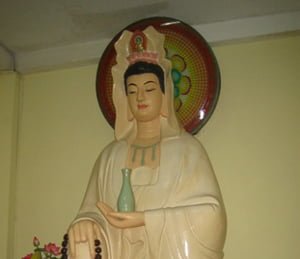
I love these little temples. My heart sings when I drive by a brick-veneer cottage and see a huge statue of Kwan Yin standing outside, sending her blessing out over the anonymous streets and cul de sacs of suburban Sydney. I know that people there still rate their spiritual life highly, and are supporting yet another humble, but terribly important, house temple.
Related Posts with Thumbnails