Showing posts with label statues. Show all posts

Monday, November 5, 2012

Countrytown Temple


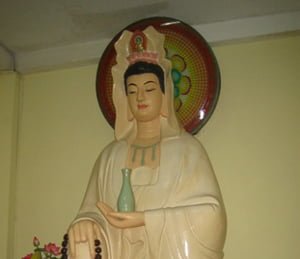
This photo was taken at a little temple in Song Be back in 1996. I was taken there on an agonisingly long trip on the back of a motorcycle, but when we arrived the temple was closed and there was no-one around.
Seeing a foreigner poking about, one of the neighbours came out, and someone was sent to fetch the monk, who was nearby.
He came back beaming, a frail, thin and elderly man. He unlocked the temple and showed me around. The whole place was dusty and uncared for, and the nighbours swept the shrine room so that we could bow to the Buddha without blackening our foreheads.
When I came to offer incense at this side shrine, where the statues were all very old and covered in years of grime, I was suddenly overcome with a kind of elation. It was one of those rare moments of transition, of self-discovery, and is impossible to put down in words. For me it was a memory, a feeling, a strange sense of belonging. I had been in this place before.
You could my response mystical, romantic, even hormonal. It may have been a practical emotional response to being accepted as family amongst all of this exotica.
But when I look at this photo it describes for me a change in lifestyle, and the beginning of an obsession.

Friday, July 16, 2010

A Di Da Phat


The name you will hear most consistently if you spend any time in Vietnamese Buddhist temples is that of Amitabha Buddha - or A Di Da Phat in Vietnamese.
The vast bulk of Vietnamese Buddhists practise a basic form of Pure Land Buddhism, and for the most part the monks advocate recitation of Amitabha's name as the most effective form of religious practice for lay-people. This is what all of those wrist malas and long prayer beads are for.
Within the temple, Amitabha's name is also a kind of shorthand replacement for everything. When you say hello, you say A Di Da Phat, when you say goodbye, when you want to attract someone's attention and when you express surprise. Once I was at temple when one of the large vases that are found in the main prayer hall tumbled over and smashed, and a number of monks looked up and exclaimed, as one, A Di Da Phat!
The true form of Buddha recitation is, of course, Nam Mo A Di Da Phat. This is enunciated clearly during communal temple worship, but at other times it is shortened to Mo Phat, and this is in fact the standard greeting amongst Buddhists, both monastics and laity.
Despite his name being constantly on everyone's lips, statues of Amitabha Buddha are not normally very prominent at temples. It is rare to have him as the main object of devotion in the prayer hall, and he is rarely seen on other shrines. Normally there is a printed image of him on the wall in the monks' offices, or a small statue on a shelf somewhere. People seem to set much greater store on statues of Kwan Yin and Sakyamuni Buddha.
One place where an image of Amitabha does become important is at people's death beds, which is why monks always have a small-ish statue of him to hand to take to hospitals and houses of the faithful, should the need arise. It is thought that if the dying person lays eyes upon an image of Amitabha, they will be reborn in his paradise.
The image with this post is from a very unusual Amitabha tower at Hien Nam Pagoda in Quy Nhon. This is the only construction of its kind I have seen in Vietnam, an 8-storied pagoda with large statues of Amitabha looking out over the four directions on each storey. It is quite beautiful, and was designed by the Abbott himself.
Related Posts with Thumbnails