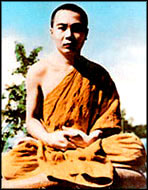
One of the most mysterious and fascinating figures in Vietnamese Buddhist history is the Patriarch Minh Dang Quang.

Though he was an enormously influential character whose legacy still thrives today in Vietnam, there is almost nothing about him in English. If there is something substantial I'd be most grateful if anyone could alert me to it. I have discovered an excellent scholarly article by Mark W. Mcleod called 'The Way of the Mendicants' which provides some excellent insights into life at Tinh Xa Trung Tam, the central monastic institution for the sect.
Minh Dang Quang was the founder of the Tang Gia Khat Si (The Mendicant Buddhist Order) - this is one of the largest Buddhist sects in Vietnam, and the Khat Si temples (known as Tinh Xa) are to be found all over Southern Vietnam (including many in Ho Chi Minh City). He was half Viet half Khmer, from Vinh Long province, and his bi-racial upbringing exposed him to both Mahayana and Theravada Buddhism. At a young age he was driven by the idea of combining the two traditions in Vietnam, the only country that could boast of sizeable numbers in each camp.
So he established the Mendicant Order, and it quickly gained in popularity, particularly in the villages and towns of the Mekong Delta. Minh Dang Quang was impressed by the strictness of the Theravadin monastic orders, and so created similar rules for his own monastics - banning the consumption of food after midday, banning the use of shoes or sandals, not allowing monks to cook or prepare their own food, encouraging them to go on begging rounds in the morning etc. He also added the additional burden of vegetarianism, which is not normally observed by Theravadin monks. He opened up the monastic vocation to women, another tradition also absent in the Theravada.
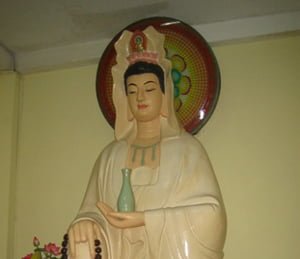
Adopting the theological structure of Mahayana almost holus bolus, he encouraged both the recitation of Amitabha Buddha's name and the worship of Kwan Yin, both of which are anathema to the Theravadin establishment.
What really popularised his movement however - aside from the great respect the people formed for the monks and nuns willing to observe such hardship - was his translation of the Buddhist sutras from the difficult (and sometimes even nonsensical) sino-vietnamese language into an easily understood and even rhyming form of the common language. The largely uneducated parishioners found it infinitely easier to remember these sutras, and to glean some meaning from them. This, naturally, made him extremely unpopular with the Mahayana Buddhist hierarchy, who accused him of corrupting the Dharma by tampering with the texts they had known since antiquity.
Sometime in the 1950s Minh Dang Quang 'disappeared' and was never seen again. There were rumours that he was assasinated by the anti-Buddhist government forces who saw him as a trouble-maker, or by agents of a rival Buddhist sect who saw his growing movement as a threat to their own power base in the Mekong Delta. His followers, however, refuse to acknowledge his death and still celebrate his 'disappearance' day each year.
An intriguing character with an intriguing story - one day I think I will write a book about him.