Showing posts with label Binh Dinh. Show all posts

Thursday, October 23, 2014

Always in threes: the significance of 3 in Buddhism

"Different schools of Buddhism all have different devotional practices to the Buddha, although all  Buddhists make symbolic offerings to the Three Jewels, that is, the Buddha (teacher), Dharma (teachings), and Sangha (community)."

Andi Young "The Sacred Art of Bowing"


Recently I was teaching a course on Vietnamese history, and naturally enough Buddhism was a part of the discussion. While discussing a ritual, one of the students asked me: "Why is everything always done in threes in Buddhism?"
I realised then that I had a lot to explain, and I thought I would do so on this blog.


When one bows at a Buddhist shrine, one always makes three prostrations. At the same time one offers three sticks of incense. When you make a ceremonial procession around a temple or tomb you do so three times.

3 sticks of incense offered at a buddhist shrine in Binh Dinh, Vietnam


This number is not arbitrary. Buddhists instantly understand that the number 3 represents the Three Jewels (the Triratna) that make up Buddhism. These are:

Sakyamuni Buddha


1. The Buddha: The person of the historical Buddha Sakyamuni.

2. The Dharma: The body of teachings that describe Buddhist doctrine and belief.

3. The Sangha: The group of people who follow the Buddha and his teachings. This was traditionally interpreted as the ordained celibate clergy who serve the Buddha exclusively, but most modern Buddhists extend the meaning to incorporate the communities of lay-people who follow the Buddhist path.

And so each time we bow, and each time we place a a stick of incense in the burner, we are recalling one of these "Jewels," these essential elements of the Buddhism. 

Friday, September 30, 2011

Quy Hoa Leper Hospital


Perhaps one of Vietnam's more peculiar tourist destinations is the Quy Hoa leper hospital in Binh Dinh province.


This is a large and quiet pleasant place situated on a beautiful beachfront just outside of Quy Nhon City. It is open to visitors (there is a small cover charge) and along the beach are cafes and restaurants that cater to visitors.
There is also a fascinating sculpture walk which has a series of busts of all of the great pioneers of medicine.


It's well worth a visit if you find yourself in Quy Nhon, one of Vietnam's best-kept secrets. People who travel to Vietnam rarely take the time to visit Binh Dinh province, which is a shame because it is a really lovely part of the country, and has a rich and fascinating history.

Friday, July 16, 2010

A Di Da Phat


The name you will hear most consistently if you spend any time in Vietnamese Buddhist temples is that of Amitabha Buddha - or A Di Da Phat in Vietnamese.
The vast bulk of Vietnamese Buddhists practise a basic form of Pure Land Buddhism, and for the most part the monks advocate recitation of Amitabha's name as the most effective form of religious practice for lay-people. This is what all of those wrist malas and long prayer beads are for.
Within the temple, Amitabha's name is also a kind of shorthand replacement for everything. When you say hello, you say A Di Da Phat, when you say goodbye, when you want to attract someone's attention and when you express surprise. Once I was at temple when one of the large vases that are found in the main prayer hall tumbled over and smashed, and a number of monks looked up and exclaimed, as one, A Di Da Phat!
The true form of Buddha recitation is, of course, Nam Mo A Di Da Phat. This is enunciated clearly during communal temple worship, but at other times it is shortened to Mo Phat, and this is in fact the standard greeting amongst Buddhists, both monastics and laity.
Despite his name being constantly on everyone's lips, statues of Amitabha Buddha are not normally very prominent at temples. It is rare to have him as the main object of devotion in the prayer hall, and he is rarely seen on other shrines. Normally there is a printed image of him on the wall in the monks' offices, or a small statue on a shelf somewhere. People seem to set much greater store on statues of Kwan Yin and Sakyamuni Buddha.
One place where an image of Amitabha does become important is at people's death beds, which is why monks always have a small-ish statue of him to hand to take to hospitals and houses of the faithful, should the need arise. It is thought that if the dying person lays eyes upon an image of Amitabha, they will be reborn in his paradise.
The image with this post is from a very unusual Amitabha tower at Hien Nam Pagoda in Quy Nhon. This is the only construction of its kind I have seen in Vietnam, an 8-storied pagoda with large statues of Amitabha looking out over the four directions on each storey. It is quite beautiful, and was designed by the Abbott himself.

Saturday, April 24, 2010

Two Qualities - Hope and Compassion


I love this photograph, which was taken at my friend's temple in Binh Dinh.
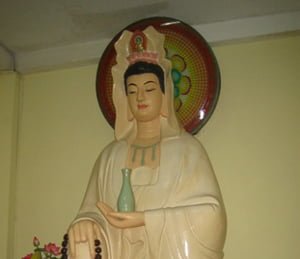
Quan The Am (Kwan Yin), the Bodhisattva of Compassion, stands on the lower terrace, and Di Lac Phat, the Buddha of the Future, stands on the upper terrace above her.
For me it represents two important qualities, qualities which my friends in Vietnam always seem to embody: Compassion and Hope.
Quan Am is the Gentle Mother, the Hearer of the Cries of the World - she can always be turned to in moments of frustration, of betrayal, of confused feelings and pain.
Above her is Di Lac (Maitreya), fat and laughing, representative of a hopeful future, a time of plenty. He always stands in a prominent place in Vietnamese temples, reminding us to retain our own lightness and sense of fun in the face of the often considerable sufferings of this world.

Friday, April 23, 2010

Binh Dinh


At Binh Dinh, an obscure little province in South-Central Vietnam which I think is one of the country’s best-kept secrets, they are really pushing a leper colony which is being run as a tourist park.
It is exquisite, I’ll give them that – the leprosarium is situated right on the ocean, and there are beachside seafood restaurants owned and operated by the lepers themselves.
But I think that pinning your hopes on a very-much-active seaside lepers' colony is a strange kind of tourist strategy.
Related Posts with Thumbnails