Showing posts with label art. Show all posts

Friday, March 26, 2010

Vietnamese words in place of Chinese characters

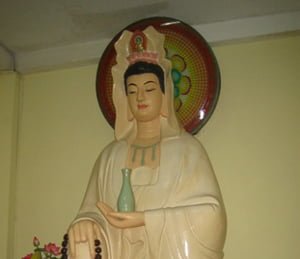
I did a talk at the Theosophical society last night, in the course of which I showed this photograph.

A friend with an eye for detail approached me later and asked me about the words running up the sides of the shrine. I explained that they were Vietnamese words shaped to look like Chinese characters. Monks have always been able to read Chinese, but have for centuries pronounced them in the Vietnamese language. These wonderful little motifs take the translation a step further, writing the actual words in Vietnamese, but leaving them roughly the same size, shape and look that the Chinese characters would have taken.
It was the first time in a long time I'd thought of this peculiar phenomenon. When I first went to Vietnam in the early 90s this was a very common motif in popular art (especially in Lunar New Year decorations), and it really struck me at the time. The words take on a wonderfully goofy 60s look, which is when I imagine they were first designed. Obviously the use of them has a vaguley nationalistic undertone, i.e. "We have perfectly good words in Vietnamese, we don't need to use Chinese to convey lofty sentiments."
I also realised that this convention is dying out in contemporary Vietnam. Partly because I imagine it appears dated to modern-day Vietnamese, bringing back as it does memories of the harshest days. I also think that with the ubiquity of Chinese-produced goods - especially in the area of Buddhist paraphernalia and New Year decorations - it is simply cheaper and easier to buy the mass-produced Chinese stuff.
So I imagine this quaint tradition is a dying art, but I have suddenly fallen in love with it.
IN a less decorative manner, I noticed that the memorial tablets on Cao Dai shrines are decorated with rather unadorned Vietnamese words. Usually such tablets would be written in Chinese.

Wednesday, March 24, 2010

Thich Ca Mau Ni Phat


In Vietnamese, Sakyamuni Buddha - the historical Buddha - is known as Thich Ca Mau Ni Phat. He is the principle figure in most temple shrines. I often wonder about this, as most Mahayana Buddhists in Vietnam have Amitabha and Kwan Yin as the central focus of their worship. And yet Sakyamuni remains as the central figure of physical reverence and the object of chanting and repentance.
Monastics take on the name Thich as their family name once they enter the monastery - Thich being the first part of Sakyamuni's name, thus signifying their leaving their earthly families and entering the family of the Buddha.
The naive Buddhist art of Vietnam is dying out now. Once upon a time each town could boast of a small workshop that made quite primitive looking plaster statues of the Buddhas. These have almost disappeared from the shops,and people favour the more expensive, mass-produced porcelain figures manufactured in China.
Temples will also often feature a large statue of the infant Sakyamuni. More properly this figure should be called the Bodhisattva, as he was yet to achieve enlightenment, but most simply call him the Baby Buddha. This statue comes into its own during the festival of Vesak (Phat Dan), the celebration of the Buddha's birth, when it becomes a special focus of devotion.

Saturday, February 27, 2010

Dia Tang Vuong Bo Tat


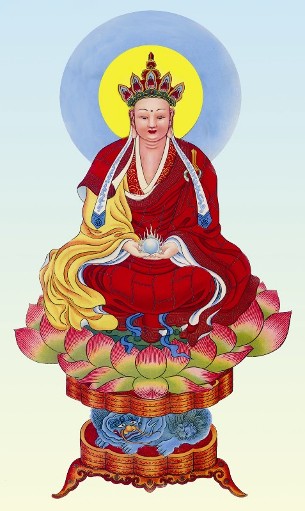
Dia Tang is the Vietnamese name for an important Mahayana Buddhist Bodhisattva known more commonly in the West by his Japanese name, Jizo.

Dia Tang is a central figure of worship because he is the protector of the dead, and is the Bodhisattva people appeal to for information about their loved ones who have passed on. In the main hall of most temples, he is the figure to the left of the main shrine, and is distinguished by his crown-like hat and the pilgrim's staff he is usually holding. He is also normally the central object of worship in the Hall of the Dead, that part of the temple where people's ashes are normally kept in porcelain urns.

So while he is an important part of religious life (the memorialising of the dead is one of the central religious duties of all Vietnamese people) I wouldn't suggest he was a "popular" figure. You never encounter busy shrines to him that have been erected by lay-people in the way they are for Kwan Yin, for example. And he is rarely to be found as a statue in people's homes. I think the associations of death that surround him are simply too strong for people to feel comfortable in his presence.

You do encounter him, however, in graveyards (and there is an enormous graveyard on the outskirts of Ho Chi Minh City), often in large and expensive statues that have been erected on top of graves. I have wanted to go to the Ho Chi Minh City cemetery and photograph it for many years, but my Vietnamese friends refuse - they think it is too spooky, and too disrespectful to the dead.

In Japan, of course, the figure of Dia Tang (or Jizo), while still considered the special protector of the dead, is an altogether more popular figure, and is frequently represented as an adorable baby monk. The complicated reasons for this are set out in Jan Chozen Bays' fascinating book Jizo Bodhisattva - an essential read for anyone interested in Buddhism.

This photograph was taken in a monk's cell in Quy Nhon. The pink porcelain Dia Tang in the foreground is new and is an import from China. Obscured behind him is a much older Vietnamese plaster statue of the Bodhisattva in a glass case.
Related Posts with Thumbnails