Showing posts with label popular art. Show all posts

Wednesday, June 6, 2012

States of Rebirth

Today I was wandering through the streets of Cabramatta when I spied, in a big pile on a shelf of free Buddhist literature outside a vegetarian supermarket, this laminated leaflet:


It transported me instantly back to Vietnam, where this particular poster is very commonly encountered, particularly in the guest rooms at temples and on the walls of vegetarian restaurants.
It is a chart of the various states of rebirth we might hope to attain.
Now of course, some of those staes of rebirth are in hell, where the wicked must pay for their torments.
This used to be a decorative motif much beloved of Buddhist temples, though it seems to have become unfashionable in recent years, and many temples have painted over their vivid wall murals depicting the various torments of hell.
I found some intact, however, at the Vietnamese Buddhist temple in Phnom Penh.


And while in Siem Reap I visited the truly ghastly Cambodian Culture Village, where the only thing even mildly amusing was the "Tunnel of Judgement" featuring 3D renderings of the punishments infliced on the evil in the hell realms.
These dioramas were a kind of torture porn, and of all the photos I took this is the ony one I can show safely on a PG rated blog:

Saturday, November 13, 2010

Vietnamese Kitsch: Lacquered Religious Pictures


When I first visited Vietnam in the mid 90s, lacquerware was just about the only handicraft item available. It was sold everywhere and lacquer factories were ubiquitous. These were Dickensian institutions, with small, thin boys, their hands and arms blackened with lacquer, toiling away in hot warehouses with sad faces. It was an old-fashioned, labour-intensive process.
Ten years later Vietnamese lacquerware became ubiquitous - not the traditional black stuff with inlaid gold and mother-of-pearl in traditional designs, but groovy rice bowls, trays and jewellery boxes. You could buy them anywhere, from Newtown to Nanjing. Indeed, even now when you go shopping for handicrafts in China a great many of the items available come from Vietnam.
Last time I was in Vietnam, however, lacquer seemed to be distinctly out of fashion. The brighly coloured, more modern items were still in evidence,but the traditional boxes and paintings had almost entirely disappeared.
What had cropped up instead were lacquered religious pictures, available very cheaply at temple and church gift shops. I bought this wonderful image of Di Lac Phat (Maitreya Buddha) at Phap Hoa Temple, and I used to hang it in my office. My friends at work called it "The Gay Buddha" - and I can kind of see what they meant.
I am a sucker for this kind of thing - I love religious imagery at the best of times - the more gaudy, the better.

Tuesday, May 25, 2010

The Bodhi Tree


There is much about popular Buddhist art in Vietnam that is kitsch. Neon halos and day-glo cement lotuses figure prominently in most temples. And at many, the main shrine to Sakyamuni is backed by an enormous representation of the Bodhi Tree - the sacred fig under which the Buddha sat and achieved enlightenment.


This tree is frequently rendered as a large trompe-l'oeil, or is moulded in cement in a uniquely unconvincing approximation of a tree.

Phap Bao Temple, Sydney

It is also common for temple gardens to contain a Bodhi Tree, normally claimed to be a direct descendant of the actual tree the Buddha sat under.

Thursday, May 20, 2010

Social Evils

You still see in Vietnam – though not as often as before – big propaganda posters exhorting people to do this, or refrain from that.
My favourite propaganda campaign happened during the mid-90s, and it was called the Stop the 7 Social Evils campaign. As the campaign gathered steam, more and more social evils were added, until eventually the posters were covered with dozens and dozens of wicked activities rendered in such small print that you could barely read them. Though of course, children would stop in front of them for hours and decipher these descriptions of wickedness.
Among the original 7 evils were prostitution, heroin and homosexuality – which kind of describes an average Saturday night in the big cities of Vietnam.


Big black serpents would be painted spitting venom, and the drops of venom took the shape of words: gambling, motorcycle racing, massage. And bia om. Bia om is a uniquely Vietnamese entertainment, in which men go to a beer garden, purchase a beer and are hugged by the waitresses. Om means to hug. I’m not for a moment pretending it’s as innocent as it sounds. But the fact is that, until the Social Evils campaign spread across the country, many regional areas had never heard of bia om. However, once this particular evil was explained to them they quickly opened such places, and now even the smallest towns in Vietnam can boast of at least one bia om establishment.

Wednesday, May 12, 2010

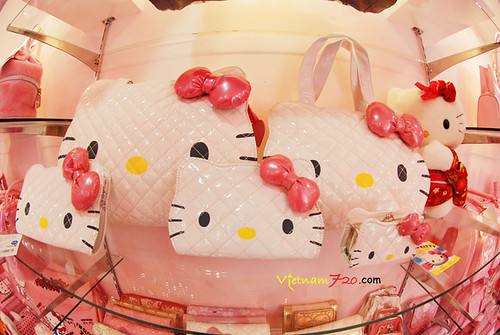
Hello Kitty


You see a lot of Hello Kitty in Vietnam.
I was delighted recently to read in the blog of one of my Twitter friends (Vietnam720) that a Hello Kitty shop has now opened in Saigon. I am so there as soon as I get back to Vietnam.
To me, Hello Kitty is just another manifestation of the feminine Divine - I'm being serious about this!
In so many ways Hello Kitty is THE great Asian Goddess. I am certain that in a thousand years time, when archaeologists are digging up the great cities of Asia, they will simply assume that people worshipped this mouthless pink cat with a ribbon in her hair, so ever-present is her image. Hello Kitty fascinates me, and I do plan to write a book about her one day – no-one better steal that idea. That’s my retirement book right there. I know an awful lot about Kitty, having once lived above a Hello Kitty shop in Taiwan. I know, for example, that Hello Kitty weighs exactly the same as three apples.
Look it up people – this kind of information is out there.


(Photo by Vietnam720)

Friday, March 26, 2010

Vietnamese words in place of Chinese characters

I did a talk at the Theosophical society last night, in the course of which I showed this photograph.

A friend with an eye for detail approached me later and asked me about the words running up the sides of the shrine. I explained that they were Vietnamese words shaped to look like Chinese characters. Monks have always been able to read Chinese, but have for centuries pronounced them in the Vietnamese language. These wonderful little motifs take the translation a step further, writing the actual words in Vietnamese, but leaving them roughly the same size, shape and look that the Chinese characters would have taken.
It was the first time in a long time I'd thought of this peculiar phenomenon. When I first went to Vietnam in the early 90s this was a very common motif in popular art (especially in Lunar New Year decorations), and it really struck me at the time. The words take on a wonderfully goofy 60s look, which is when I imagine they were first designed. Obviously the use of them has a vaguley nationalistic undertone, i.e. "We have perfectly good words in Vietnamese, we don't need to use Chinese to convey lofty sentiments."
I also realised that this convention is dying out in contemporary Vietnam. Partly because I imagine it appears dated to modern-day Vietnamese, bringing back as it does memories of the harshest days. I also think that with the ubiquity of Chinese-produced goods - especially in the area of Buddhist paraphernalia and New Year decorations - it is simply cheaper and easier to buy the mass-produced Chinese stuff.
So I imagine this quaint tradition is a dying art, but I have suddenly fallen in love with it.
IN a less decorative manner, I noticed that the memorial tablets on Cao Dai shrines are decorated with rather unadorned Vietnamese words. Usually such tablets would be written in Chinese.
Related Posts with Thumbnails