Showing posts with label books about Vietnam. Show all posts

Sunday, February 14, 2016

Vietnam Books - Something to Read Before You Go

If you're anything like me, reading books about a place is one of the most pleasurable parts of preparing for a holiday abroad. Here is my reading list for Vietnam:


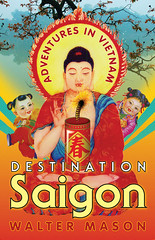
Walter Mason's Destination Saigon - Ok, ok, so I wrote it. But honestly, if you want an intimate view of contemporary Vietnamese religion, culture and sexual mores, and a bit of a giggle, then this is where you should start. So many books about Vietnam are about the war or about colonial history. I set about writing a book that was telling stories of Vietnam now, and I really think I succeeded!


Andrew X Pham's Catfish and Mandala - Quite a superbly written book that is about so much more than Vietnam, this is a unique and compulsive read that offers a great deal of insight into what it's like to be an overseas Vietnamese returning home as a stranger. Books about Vietnam are normally told from the perspective of a foreigner, or are translated works by people living in Vietnam.


Gontran de Poncins' From a Chinese City - A French Count goes to spend a few months in Cholon, Saigon's Chinatown, in the 1950s. This is such a gorgeous book, and absolutely fascinating. There are very few books on Vietnam that deal with the Chinese community in any detail, so this is a real rarity.


Norman Lewis' A Dragon Apparent - More Indochina in the 50s, Lewis' quiet British fortitude makes him an excellent observer, and his love of the Vietnamese comes seeping through. Vietnam travel books are surprisingly rare, and really good ones rarer still. Lewis' is the best.


Graham Greene's The Quiet American - Yeah, yeah, I know it's on every list, but really it is quite perfect, and you can still visit most of the places he mentions in the book. If you're going to Vietnam, do make sure you read this book first.


Marguerite Duras' The Lover - Especially if you are planning on having an affair with a Vietnamese guy (though the lover is actually Chinese). Sensuous, historically fascinating and quite dazzlingly accurate. Not really full of Vietnam tips, but it creates the most wonderful mood and evokes an incredible era that is only now beginning to be romanticised and even celebrated in Vietnam.


Thich Nhat Hanh's Zen Keys - A unique insight into Vietnamese Buddhist monasticism. As well as information about the philosophy of Buddhism, it provides a great story to read about the life of a young monk, and how they were once expected to behave inside the Chua (Pagoda).


Kien Nguyen's The Unwanted - Absolutely the best account of what Vietnam was like in the years immediately following the end of the war. This book is a masterpiece and deserves to be better known. Don't wait to buy this one - it is one of the really good Vietnam books, and one of the most unique perspectives.


Duy Long Nguyen's The Dragon's Journey - A memoir about a Vietnamese refugee's journey to Australia, where he becomes a famous healer. A book about Vietnam and about the journey of the Vietnamese dispora.


Stanley Karnow's Vietnam: A History - Pretty solid going, but once you've finished it you will be entirely informed about the complex and long-lasting Vietnam war.


Ma Van Khang's Against the Flood - A little-known but fascinating fictional peek into the ghastly bureaucracy and stifling conservatism of Vietnamese life in the 80s and 90s.

Thursday, January 29, 2015

Walter Mason illustrated lecture on Graham Greene's Vietnam


I'll be at Ashfield Library on Saturday February 7, 2015 from 11am - 12pm in the Local Studies Room (just off the main library floor), Level 2, Civic Centre talking about Graham Greene, Vietnam and The Quiet American and I would love to see you there.

I have been obsessed with Greene's short and perfect novel about Vietnam ever since I first read it when I visited Vietnam at the age of 24.

My interest in The Quiet American, and Greene the writer, has only grown over the years.

I am delighted to be able to show you some of Greene's novel and where and how it is reflected in Vietnam in the 21st Century.

Do join me at this free talk illustrated with my own photos and reflections.

I can promise you an engaging and entertaining hour.

Monday, October 25, 2010

Books About Vietnamese Buddhism

There is remarkably little in English about Vietnamese Buddhism.
Of course, I am excepting here the vast body of work of Zen Master Thich Nhat Hanh, who has almost single-handedly introduced Vietnam's distinct version of Mahayana Buddhism to the world. But so much of his writing is about Buddhist doctrine and practice, and is intentionally not culturally focused. For a real insight into Vietnamese Buddhist culture I recommend his book Zen Keys, which goes into some detail about his training as a monk in Vietnam, and is a great read.
But the historical and cultural aspects of Vietnamese Buddhism are still largely unadressed in English, and were my Vietnamese language skills better I would like to do some academic work in this area. Indeed, the whole reason I went to learn Vietnamese in 1999 was so that I might be able to do exactly this kind of work. But I am by nature a lazy man, and so I never really acquired the necessary skills. I guess it's never too late.
Anyway, I have on my desk two books that I will be reading this month that are absolutely fascinating, and very helpful to me as a lover of Vietnam and an amateur scholar of Vietnamese religion and culture.


Buddhism in Vietnam: Past and Present by Bhikkhuni Tri Hai - this book was presented to me back in the 90s by the author herself. It is really just a pamphlet, photocopied and bound and distributed among the elder nun's friends and students. Bhikkhuni Tri Hai was Vietnam's most respected female Buddhist monastic, and lived on the grounds of Van Hanh Buddhist University, until her tragic death in a car accident some years ago. I was lucky enough to know her, and she was charming, wise and incredibly inspiring. In fact, I have read this little book many times, and drew on it's information extensively when writing my own book, Destination Saigon. Elder Nun Tri Hai's view of Buddhism was eccentric and modern, and I find this book constantly challenging (in a good way) and a fascinating angle on the meanings of Buddhism and Buddhist monasticism in particular.


Buddhism in Vietnam by Minh Chi et al - A wonderfully shoddy paperback produced by the The Gioi government publishing house in Hanoi, this little book is deathly dull, but an excellent source of nuts and bolts information. It is easily available in bookshops in Vietnam that cater to foreigners, but be warned, it is not the kind of thing you'd read for pleasure. Indeed, even reading it purely for information can be a struggle, so woefully has it been translated. Nonetheless, it is the most thorough-going history of Buddhism in Vietnam, and all the names, dates and places are there. I have never actually read it cover to cover - I doubt it is possible.

Thursday, April 1, 2010

Walter Mason Speaking at Cafe Church, Chapel by the Sea, Bondi Beach


7pm Sunday APRIL 11
@Chapel by the Sea, Bondi Beach

Address: 95 Roscoe Street, Bondi Beach NSW

Phone: 02 9130 3445

Walter will be talking about spiritual life in contemporary Vietnam, and will lead an exercise in prayer and meditation on the prayer bells.

Walter is an academic and writer with a long-standing interest in meditation, prayer and other contemplative practices.

Walter has travelled extensively throughout Asia, and has spent long periods studying Buddhism and meditation in Vietnam, Thailand, Taiwan and Cambodia.

These days Walter is firmly committed to the idea of Interfaith spirituality, and is convinced of the possibility of meaningful exploration of plural spiritual paths. At present Walter's spiritual journey could be defined as Buddhist-Christian, with input from the ideas of Christian mystic Emanuel Swedenborg and inspired by the example of the Hindu mystic Ramakrishna.

Committed to the practice of meditation as an effective tool for spiritual exploration, Walter's approach is gentle and focused on individual needs. Rejecting the idea that 3 hours a day squatting on the floor is essential, Walter teaches that even 5 minutes a day of mindful sitting or movement can have a positive effect on people's lives.

Walter is the author of a spiritual travel book called Destination Saigon, recently released by Allen & Unwin. www.destination-saigon.com


Tuesday, March 30, 2010

Friendship Bridge


Back in the late 90s I began to hear from my friends in Vietnam about an amazing new bridge that was being built to span the Mekong between (I think) My Tho and Vinh Long (or close enough). All of the Vietnamese that I spoke to were in genuine awe of the project - the first of its kind. Crossing the Mekong by ferry between major cities and provinces is a particularly gruelling experience, and in recent years there had been a number of deaths caused by over-full cars and buses plunging into the river from the ferry or the jetty. The bridge was viewed with genuine gratitude by the Vietnamese people, and was responsible for a tremendous amount of good will being built up between Australia and Vietnam.
When it was opened I was invited to visit Can Tho by some Khmer friends in Saigon. We hired a car, and everyone was very excited to be crossing over the bridge for the first time. There were signs all over the bridge warning vehicles not to stop at any point. Exactly halfway across, my monk friend Son Thua ordered the driver to stop so that we could all get out and take a photograph. The driver was hesitant, but he didn't dare disobey.
And so we got out and stood in an outer lane, traffic whizzing by us dangerously, and took some snaps to commemorate this special bridge and our special trip.
Laky, on the left, had only just left the monastery. The monk Son Thua these days lives in Burma, where he has mastered English and become something of a meditation master.
I am still in touch with both.

Monday, March 29, 2010

Banh Mi Op La


One of the yummiest - and simplest - breakfasts I enjoy while I am in Vietnam is the humble Banh Mi Op La. This is a simple fried egg served with a baguette (I always ask for an extra straight up). You then make it your own with the judicious addition of soy-sauce (or, more properly, the enhanced soy-sauce which is normally served in Vietnam callen nuoc tuong), chilli sauce and salt & pepper. Using the bread as an eating implement, you eat your fried egg (necessarily with a runny yolk) and you are all ready for the day. It's perfect if you've grown a little tired of the more exotic options and want something that is closer to a western breakfast.
Banh mi op la is readily available on the streets of Ho Chi Minh City, though I'm not so sure about other cities.

Saturday, March 27, 2010

Van Hanh Buddhist University


One of the places I mention in Destination Saigon, and a place that has had a significant influence on my spiritual formation, is Van Hanh Buddhist University in Ho Chi Minh City.
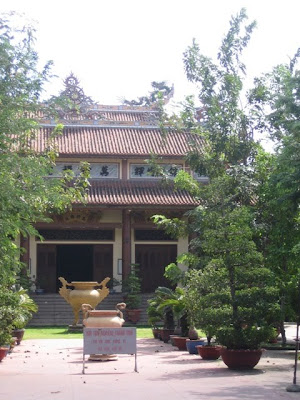
It was here that I met one of my great spiritual mentors, way back in 1996. Back then it was a dusty and rather ramshackle place. Originally established by Thich Nhat Hanh in the 60s, it hadn't been renovated much since then, and was a tacky collection of wooden buildings that hosted scores of Buddhist monks and nuns studying there from all over the country. I used to just go there and hang out (there was a cafe on the premises back in those more permissive days), and I made so many friends. It was quite a sexist institution then, and monks got to study in the relative cool of the morning, while nuns were forced to do their classes in the hot afternoon. By 1999 the rules had changed, and each year the order of classes was swapped around - nuns got mornings one year, monks the next.
These days Van Hanh is a thoroughly modern co-educational institiution, and monks and nuns attend the classes together. It is quite a unique place in that monastics from all the Buddhist schools and sects study together. A couple of years ago lay-people were allowed for the first time to study there too, which was something radically new.
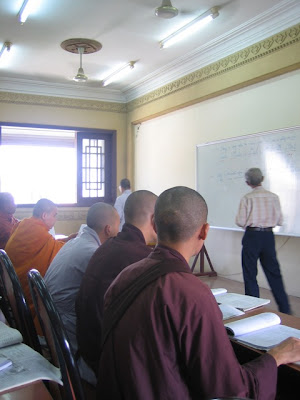
Until 2000, as I mentioned, the facilities were basic, at best. The grounds also housed a resident monastery, and in a distant corner a walled-off nunnery that served as a hermitage for Su Ba Tri Hai, one of Vietnam's most revered religious figures. It was in this peaceful little hermitage that I used to take my lunch with my elderly grandparents when they would visit me in Vietnam. The Elder Nun Tri Hai lived as a recluse, and she sadly died a few years ago, killed in a car accident on Vietnam's incredibly dangerous roads. She and her sister nuns were returning from doing some charity work at one of Vietnam's leprosariums.
In recent years a Taiwanese Buddhist group has pumped a lot of money into Van Hanh, and it is filled with big, beautiful new buildings and classrooms. There is still a resident monastic community, but the nun's hermitage was demolished after Su Ba Tri Hai's death.
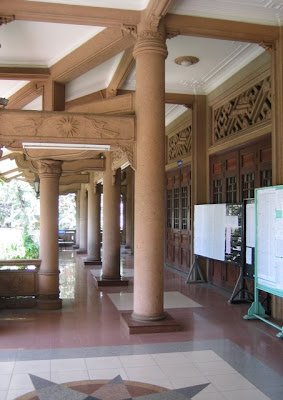
If you wanted to visit it now you would probably have to have a good reason, as visitors are no longer encouraged on the grounds, and there is no where to hang out at any rate. The temple functions as a working house of worship, so prayers are held there every evening, and anyone can attend them - if you arrive early it might give you a legitimate reason to have a look around the place.

Friday, March 26, 2010

Vietnamese words in place of Chinese characters

I did a talk at the Theosophical society last night, in the course of which I showed this photograph.

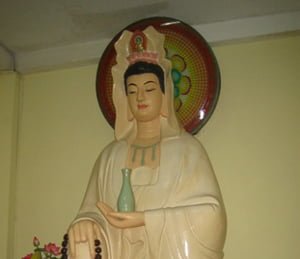
A friend with an eye for detail approached me later and asked me about the words running up the sides of the shrine. I explained that they were Vietnamese words shaped to look like Chinese characters. Monks have always been able to read Chinese, but have for centuries pronounced them in the Vietnamese language. These wonderful little motifs take the translation a step further, writing the actual words in Vietnamese, but leaving them roughly the same size, shape and look that the Chinese characters would have taken.
It was the first time in a long time I'd thought of this peculiar phenomenon. When I first went to Vietnam in the early 90s this was a very common motif in popular art (especially in Lunar New Year decorations), and it really struck me at the time. The words take on a wonderfully goofy 60s look, which is when I imagine they were first designed. Obviously the use of them has a vaguley nationalistic undertone, i.e. "We have perfectly good words in Vietnamese, we don't need to use Chinese to convey lofty sentiments."
I also realised that this convention is dying out in contemporary Vietnam. Partly because I imagine it appears dated to modern-day Vietnamese, bringing back as it does memories of the harshest days. I also think that with the ubiquity of Chinese-produced goods - especially in the area of Buddhist paraphernalia and New Year decorations - it is simply cheaper and easier to buy the mass-produced Chinese stuff.
So I imagine this quaint tradition is a dying art, but I have suddenly fallen in love with it.
IN a less decorative manner, I noticed that the memorial tablets on Cao Dai shrines are decorated with rather unadorned Vietnamese words. Usually such tablets would be written in Chinese.

Monday, March 22, 2010

Walter Mason at Shearer's Bookshop


Walter's talk tonight was another full house.  In fact some had to be turned away.  It was a great event, thanks to Barbara (below) and Tony at Shearer's.


Special mention to all the friends and family who came along and also the wonderful author, Stephanie Dowrick (below).


Walter Mason speaking at MCC Good Shepherd, Sunday 21st March


Walter giving a talk to MCC Church about his spiritual journey in Destination Saigon.

Author ecounter @ Lindfield Library : Walter Mason


Author Encounter at Lindfield Library with Walter Mason

When: Wednesday 24 March
Venue: Lindfield Library, 265 Pacific Highway, Lindfield
Time: 10.00am for a 10.30am start
Cost: $5.00 (includes light refreshments)
Bookings are essential and can be made at all branches of Ku-ring-gai Library, by phoning 94240 428 or emailing us at lind.library@kmc.nsw.gov.au
Books will be available for purchase and signing by the author.

About the talk

From the crazy heat and colour of Saigon to the quieter splendour of Hanoi, Walter Mason gives us a rare, joyous and at times hilarious insight into twenty-first century Vietnam. Seduced by the beauty and charm of its people, and the sensuousness of its culture, we can almost taste the little coconut cakes cooked over a fire in a smoky Can Tho kitchen, or smell the endless supplies of fresh baguettes and croissants just out of city ovens.

Travelling off the beaten track to far-flung villages and lesser-known towns, we cruise along the Mekong, board hopelessly overcrowded local buses or perch perilously on the back of motor-bikes. Behind-the-scenes visits to Buddhist monasteries reveal a quieter and more transcendent world beyond the busy day trips of tourists. And in the process we begin to see the country through the eyes of its people.
Join us as we get a taste of the real Vietnam and its people on a sometimes funny, always fascinating journey from the bustling cities to out of the way villages, into Buddhist monasteries and along the Mekong - a real delight for armchair travellers and those contemplating their own adventure.

Sunday, March 21, 2010

IN THE TOP 50 SALES CHART

Destination Saigon continues to surprise.  The first book, by first time author, Walter Mason is 47th in the top 200 sales charts for Independent Bookshops in Australia!  Yeah!

Thursday, March 18, 2010

Destination Saigon in the Shops


As a first-time author, probably one of the most thrilling events is to walk into a shop and see your book on the shelves. Oh, the heaven! I just want to shout, to grab the person next to me and say "That's by me - see, we have the same name. Do you want to see my ID?" Or I want to take a copy off the shelf and walk up to the shop assistant and say "I'm the author of this book, how's it selling?"
I don't do the latter because I was myself a bookseller for many years, and it was the kind of things authors frequently did, and it was not endearing.
So I quietly smile to myself and surreptitiously take some snaps of the happy event with my phone. It still hasn't gotten old.
Of course, I have friends in the bookselling world, and they have been so wonderful, selling my book like crazy and doing everything they can to turn it into the wild success it has become.
Over at Better Read Than Dead they have made it their book of the month, with a front window and posters, no less!
And my old friends and colleagues at Adyar have constructed a little Destination Saigon shrine. Next time I come in I'm going to offer some incense and flowers.

Sunday, March 14, 2010

Way2Go Magazine: Destination Saigon Extract


Way2Go Magazine, March - April 2010 edition, extract of Destination Saigon and exclusive photos by Walter Mason

Saturday, March 13, 2010

Dan Viet Newspaper Destination Saigon Feature by Ngoc Han, 12 March 2010

The Australian, Extract of Destination Saigon

Traveller (Sydney Morning Herald, The Age) review of Destination Saigon

Destination Saigon, by Walter Mason
Allen & Unwin, $24.99
Reviewed by Bruce Elder,
Traveller, Sydney Morning Herald & The Age
Saturday, 13th March 2010


When it comes to evaluating and commenting on the nature of a soceity, there is no substitute for the thoughtful objectivity of an outsider who has fallen in love with the place.

This describes Walter Mason, an Australian who followed his Vietnamese partner, settled in Ho Chi Minh City in the mid-1990s and has since visited the country 11 times.  He understands Vietnam with a level of wry fascination and when it comes to the idiosyncrasies of the culture, he speaks the language and can ask a local exactly what is happening.

Consequently, this interesting and well written book, apart from being an engrossing narrative of life in Vietnam, is full of useful and practical insights.

For example: "If you are ever looking for a hotel in Hanoi, I recommend you check the room before you agree to the tariff.  Rooms with windows can be rare in the city, so it is easy to disappear into a black hole of a room with no circulation and ample damp, and quite possibly fall asleep for days, waiting for a dawn."

And one of my favourite insights: "for a foreigner, getting a legitimate massage in Vietnam can be quite a difficult thing and I had heard horror stories of notorious goings-on even in five-star hotel spas." Do you really want to know more?

An example of quirkiness - and this is what helps make this unusual book so engrossing - is Mason's description of a leprosarium, in Binh Dinh province, that the local tourist authority has tried to turn into a tourist attraction: "As leprosariums go it is quite nice, situated gorgeously by the ocean, replete with coffee shops and restaurants run by the lepers themselves." And then, with just the right level of eyebrow-raising, he adds: "But as a tourist attraction I think it's a abit of a tough sell."

Mason obviously loves the country and it's people.  In many ways, this is his love letter to Vietnam.  More than a guidebook, it's a story full of insights that will help visitors to understand the unique cultures of Vietnam.

Tuesday, February 23, 2010

Catfish & Mandala


People often ask me what books about Vietnam I could recommend.
Aside from Destination Saigon (naturally), one of my all-time favourites is Andrew X. Pham's exquisite travel-memoir Catfish & Mandala. This book has been around for a while now, and has a real cult following, especially among those who have visited Vietnam.


Pham is an American-Vietnamese, and in this book he decides to re-visit his homeland. A committed bike-rider and something of an idealist, Pham's return is hardly triumphant, and from the beginning he experiences cultural confusion when he cannot be the person his family in Vietnam want him to be.
Throughout the book his journey through Vietnam is interspersed with stories of his life as a refugee boy growing up in the States. His wonderfully dysfunctional family (including a gay brother and a transsexual sister) are constantly examined and pulled into focus as events in Vietnam remind him of his fractured, multi-cultural experience.
Pham is honest in this book, painfully so. He is unafraid to represent himself as a paranoid whinger, or to discuss difficult aspects of contemporary Vietnamese culture. In fact, I really do rate this as one of the best - and most original - travel books ever written.
Essential reading if you're headed to Vietnam.
Related Posts with Thumbnails