Thursday, March 25, 2010

Lu Dongbin


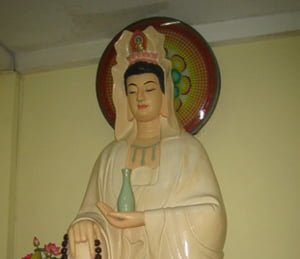
This pic was taken at my friend's Taoist Feng Shui Fortune Telling business on the West Lake in Hanoi - a place that I talk about in my book, Destination Saigon. It is a statue of Lu Dongbin - a figure I didn't know much about until I encountered him in my friend's shop.
It seems that Lu Dongbin is something of a Patron Saint to practitioners of the Taoist arts.
He is also one of the most commonly appearing deities in the world of Chinese folk religion, though he is almost completely unknown to non-Chinese. It seems that in the early part of the 20th Century the cult of Lu Dongbin was particularly popular in Southern China, which explains his presence in so many temples in Hong Kong, and among the Chinese diaspora abroad.
Interestingly, a fable about Lu Dongbin is retold in Liao Fan's Four Lessons - one of my favourite books:

"Lu Dongbin was being taught the art of transforming iron into gold. They would use this gold to help the poor. Dongbin asked his teacher,"Will the gold ever change back to iron?" Li Jung answered, "After five hundred years, it will return to its original form." Dongbin said, "In that case, I do not want to learn this art for it will harm those who possess the gold five hundred years from now." Li Zhong said, "To become an immortal, one must complete three thousand virtuous deeds. What you have just said came from a truly kind heart. Your three thousand deeds are fulfilled.""

Wednesday, March 24, 2010

Thich Ca Mau Ni Phat


In Vietnamese, Sakyamuni Buddha - the historical Buddha - is known as Thich Ca Mau Ni Phat. He is the principle figure in most temple shrines. I often wonder about this, as most Mahayana Buddhists in Vietnam have Amitabha and Kwan Yin as the central focus of their worship. And yet Sakyamuni remains as the central figure of physical reverence and the object of chanting and repentance.
Monastics take on the name Thich as their family name once they enter the monastery - Thich being the first part of Sakyamuni's name, thus signifying their leaving their earthly families and entering the family of the Buddha.
The naive Buddhist art of Vietnam is dying out now. Once upon a time each town could boast of a small workshop that made quite primitive looking plaster statues of the Buddhas. These have almost disappeared from the shops,and people favour the more expensive, mass-produced porcelain figures manufactured in China.
Temples will also often feature a large statue of the infant Sakyamuni. More properly this figure should be called the Bodhisattva, as he was yet to achieve enlightenment, but most simply call him the Baby Buddha. This statue comes into its own during the festival of Vesak (Phat Dan), the celebration of the Buddha's birth, when it becomes a special focus of devotion.

Tuesday, March 23, 2010

Theravadin Monk, Dong Nai


This pic dates back to 1999, when I was in Vietnam studying the Vietnamese language at the Ho Chi Minh Social Sciences University in Saigon. Back then I was really involved with the Vietnamese Theravadin community, which is reasonably small. In fact, I had taken refuge with one of Vietnam's leading Theravadin masters, and this young monk was one of his charges.
We became great friends, and used to spend a lot of time together. He was always slightly naughty, so it was no surprise when I returned to Vietnam a couple of years later to hear that he had left the monkhood in order to get married.
This photo was taken during the Kathina celebration at a forest monastery in Dong Nai, just outside of Ho Chi Minh City.

Monday, March 22, 2010

Walter Mason at Shearer's Bookshop


Walter's talk tonight was another full house.  In fact some had to be turned away.  It was a great event, thanks to Barbara (below) and Tony at Shearer's.


Special mention to all the friends and family who came along and also the wonderful author, Stephanie Dowrick (below).


Walter Mason speaking at MCC Good Shepherd, Sunday 21st March


Walter giving a talk to MCC Church about his spiritual journey in Destination Saigon.

Author ecounter @ Lindfield Library : Walter Mason


Author Encounter at Lindfield Library with Walter Mason

When: Wednesday 24 March
Venue: Lindfield Library, 265 Pacific Highway, Lindfield
Time: 10.00am for a 10.30am start
Cost: $5.00 (includes light refreshments)
Bookings are essential and can be made at all branches of Ku-ring-gai Library, by phoning 94240 428 or emailing us at lind.library@kmc.nsw.gov.au
Books will be available for purchase and signing by the author.

About the talk

From the crazy heat and colour of Saigon to the quieter splendour of Hanoi, Walter Mason gives us a rare, joyous and at times hilarious insight into twenty-first century Vietnam. Seduced by the beauty and charm of its people, and the sensuousness of its culture, we can almost taste the little coconut cakes cooked over a fire in a smoky Can Tho kitchen, or smell the endless supplies of fresh baguettes and croissants just out of city ovens.

Travelling off the beaten track to far-flung villages and lesser-known towns, we cruise along the Mekong, board hopelessly overcrowded local buses or perch perilously on the back of motor-bikes. Behind-the-scenes visits to Buddhist monasteries reveal a quieter and more transcendent world beyond the busy day trips of tourists. And in the process we begin to see the country through the eyes of its people.
Join us as we get a taste of the real Vietnam and its people on a sometimes funny, always fascinating journey from the bustling cities to out of the way villages, into Buddhist monasteries and along the Mekong - a real delight for armchair travellers and those contemplating their own adventure.

Sunday, March 21, 2010

What shoes to take to Vietnam


Sometimes I think it's the really small details, the truly mundane, that you forget to ask about before you go to visit a foreign country. You'll spend months researching the religion, the culture and the history of your intended destination, but you'll forget to find out what people eat for breakfast, or is toilet paper readily available, or can you buy Mentos at short notice. And, ironically, it is these little things that can make a real difference to how you travel and the quality of your trip.
So I see myself as something of a shoe ambassador. Shoes are an important consideration in Vietnam.
Now, it's obvious that when you go on holiday you're going to be doing a lot of walking, and so you will need a pair of shoes that will facilitate that. Most Western travellers tend to plump for desert boots or fancy lace-up sports shoes when they travel. But both of these are a disaster in Vietnam.
Because, as in most countries in Asia, the Vietnamese are sticklers for the removal of footwear, often in the most unexpected places. I mean, it's obvious that you are going to have remove your shoes when you visit a temple or sacred shrine. But do you know that if (God forbid) you have to visit the dentist in Vietnam you will be required to remove your shoes?
So those expensive walking shoes you thought were just perfect for foot slogging will soon become a curse as you find yourself hunched over for the thriteenth time that day lacing them up at some doorway or other.
When I go to Vietnam I only pack two types of footwear. Some comfortable leather casuals that slip on and off easily. Skechers or Hush Puppies are perfect, as they can be streetwear, walking shoes or going out shoes. And I also carry a pair of casual leather flip-flops for when I am hanging out - they are cool (i.e. not hot), and flip-flops are what about 95% of Vietnamese wear. If you buy nice ones, you can wear them almost everywhere. Because you almost always leave your shoes at the door, you can even team them with quite a dressy outfit.
Am I sounding like Carson Kressley?
Related Posts with Thumbnails