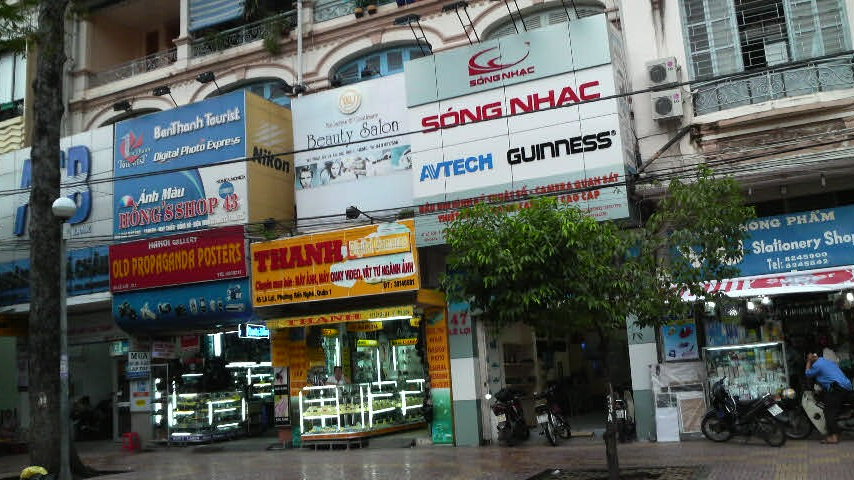
Ho Chi Minh City is crowded by anyone's estimation. Officially the population of the city is 9 million, though most experts say there are a couple of million on top of that. Even a cursory glance at the city's population will reveal that almost everyone you meet, and certainly everyone that works for you or serves you, is not officially a resident, so heaven knows how many people are actually living there. It is crowded and cramped, and real estate has become insanely expensive - buying a house in the city area is far more expensive than buying a house in Sydney, for example, but people earn only a fraction of what people in Australia earn, so in real terms the cost of housing is truly astronomical. So people tend to build up. Every time I return to Vietnam people in "The City" have added another floor to their houses, and long, steep and perilous stairways are very common in urban Saigon dwellings. One stumbles upon some quite extraordinary architecture, and a distinct "Saigon" look has emerged in the last few years. I love buying all the Home Beautiful style magazines when I am there to see how the rich are building and decorating their often quite tiny homes. Getting around in Ho Chi Minh City can be quite difficult, with houses hidden down a bewildering series of alleys, leaving you looking for addresses like 1/6/31/8/ bis Pham Van Hai. Each number indicates an alley you need to turn down, and heaven help you if you make a wrong turn - re-tracing your steps can take up a lot of time, and leave you emerging into streets and districts you've never seen before. The residents of Saigon, too, are inveterate shopkeepers, and houses frequently feature a business of some sort in the downstairs front room. Frequently, in order to get to an actual house, you have to tramp through the premises of a cafe, a pharmacy or a dressmaker.
Before I was an author I spent many years as a bookseller.
What authors don’t realise is that, unless they are a big name, booksellers are just about their most important customer. It is the individual bookseller who ultimately makes the really big decisions about how many copies of your book they will order, where they will place it in the store, how much they will promote and hand-sell it, and whether or not they will continue to keep it in stock as a backlist item after the book’s initial release.
But most authors treat booksellers with contempt and frequently establish a hostile relationship with them. When I was a bookseller I would often be subjected to a tirade from some C-list (and sometimes from A-list ones, but they can normally get away with it) author, and you can bet the tales of his/her arrogance and repulsiveness would spread like wildfire through the industry.
Authors need to cultivate the best possible relationship with booksellers – all booksellers. You need them. They don’t need you. Ponder that power imbalance for a while before you next decide to whine at one.
So, for the benefit of new, or even established, authors, allow me to present to you the Top 5 things that authors do to piss off booksellers:
1. Whine about your book not being in stock: It’s not your business, and they are under no obligation to stock your book, no matter how brilliant you might think it is. There are all kinds of reasons you might not be able to see your book on their shelves – not least of which being that it might have just sold out and they are about to order 10 more because they love it so much. If they really are not stocking your book, respect their choice, and try to think of a way to charm/convince them into believing that they should. Send them a reading copy. Introduce yourself, give them a flier about your book and tell them that you love their shop and want to be able to send locals to it.
2. Whine about your book not being in a prominent position: This is a remarkably common occurrence. The author of some obscure book comes in and complains that their book isn’t displayed on the front counter, or in a huge pile at the front next to the Twilight books. I remember once a really horrible woman came and did this to me when I was just starting out in the trade. I looked her book up on the inventory system and in the notes field it said “Small, dull purple book. Author is an absolute bitch.” A year later I was backlist buyer, and when this same book came up on my list to re-order I took great pleasure in changing its status to “Customer Order Only.”
3. Whine about not having enough stock of your book: Most bookstores carry an enormous quantity of books – tens of thousands of different titles in some cases. For the most part this stock is managed by sophisticated and complicated electronic inventory systems, backed up by literate and experienced buyers who know their customers well. If there’s only one copy of your book in stock there’s normally a really good reason for it. If you want that to change, then pull your finger out and get promoting your book using any means possible. Don’t blame the bookseller. On the other hand, I was working one day when a very friendly and charming American woman came up to me and said, “Hi, I’m Robin Norwood, author of Women Who Love too Much. I just wanted to tell you what a beautiful store you have – I have been in here for hours!” I thanked her and told her that we had some of her books in stock. “You keep my books!" she cried. “Why, that’s a real honour. Thank you so much.” A very classy lady. For the rest of my buying career I always kept face-out quantities of Robin Norwood books in stock.
4. Make a big fuss about holding a reading/signing/other event and then have no-one turn up: Yes, I know it is a bookseller’s responsibility to promote such events, but I have seen too often a new or unknown author harass a bookseller into hosting an event for them. Then the author does absolutely nothing to promote it, brings along no-one, and the whole thing becomes a dismal flop and a waste of time. If you are starting out and someone is kind enough to host an event for you, you really do have an obligation to lean on your friends, family, cheerleading crew etc. to come along to these events and make them a success. This is just really basic stuff.
5. Be rude to/harass counter staff in your quest to get to the buyer/manager/owner: There is no small fry in the world of bookselling. Those people out front are the very same ones who are going to be recommending your book, pointing it out to shoppers, talking about it, and asking the buyers why the hell it’s not in stock because they could have sold a dozen copies of it yesterday. You NEED those people on your side. In the same vein, if you are lucky enough to have a reading/signing or other event at a bookstore, treat all the staff with courtesy and regard. The people who serve at the counters and stack the shelves at bookstores tend to be among the most educated, creative and intelligent in the world, and most of them are gonna be someone someday soon. You can’t afford to appear arrogant or contemptuous to anyone in a bookstore – they might be publishing your next book in a couple of years time.
7pm Sunday APRIL 11
@Chapel by the Sea, Bondi Beach
Address: 95 Roscoe Street, Bondi Beach NSW
Phone: 02 9130 3445
Walter will be talking about spiritual life in contemporary Vietnam, and will lead an exercise in prayer and meditation on the prayer bells.
Walter is an academic and writer with a long-standing interest in meditation, prayer and other contemplative practices.
Walter has travelled extensively throughout Asia, and has spent long periods studying Buddhism and meditation in Vietnam, Thailand, Taiwan and Cambodia.
These days Walter is firmly committed to the idea of Interfaith spirituality, and is convinced of the possibility of meaningful exploration of plural spiritual paths. At present Walter's spiritual journey could be defined as Buddhist-Christian, with input from the ideas of Christian mystic Emanuel Swedenborg and inspired by the example of the Hindu mystic Ramakrishna.
Committed to the practice of meditation as an effective tool for spiritual exploration, Walter's approach is gentle and focused on individual needs. Rejecting the idea that 3 hours a day squatting on the floor is essential, Walter teaches that even 5 minutes a day of mindful sitting or movement can have a positive effect on people's lives.
Walter is the author of a spiritual travel book called Destination Saigon, recently released by Allen & Unwin. www.destination-saigon.com
Back in the late 90s I began to hear from my friends in Vietnam about an amazing new bridge that was being built to span the Mekong between (I think) My Tho and Vinh Long (or close enough). All of the Vietnamese that I spoke to were in genuine awe of the project - the first of its kind. Crossing the Mekong by ferry between major cities and provinces is a particularly gruelling experience, and in recent years there had been a number of deaths caused by over-full cars and buses plunging into the river from the ferry or the jetty. The bridge was viewed with genuine gratitude by the Vietnamese people, and was responsible for a tremendous amount of good will being built up between Australia and Vietnam.
When it was opened I was invited to visit Can Tho by some Khmer friends in Saigon. We hired a car, and everyone was very excited to be crossing over the bridge for the first time. There were signs all over the bridge warning vehicles not to stop at any point. Exactly halfway across, my monk friend Son Thua ordered the driver to stop so that we could all get out and take a photograph. The driver was hesitant, but he didn't dare disobey.
And so we got out and stood in an outer lane, traffic whizzing by us dangerously, and took some snaps to commemorate this special bridge and our special trip.
Laky, on the left, had only just left the monastery. The monk Son Thua these days lives in Burma, where he has mastered English and become something of a meditation master.
I am still in touch with both.
One of the yummiest - and simplest - breakfasts I enjoy while I am in Vietnam is the humble Banh Mi Op La. This is a simple fried egg served with a baguette (I always ask for an extra straight up). You then make it your own with the judicious addition of soy-sauce (or, more properly, the enhanced soy-sauce which is normally served in Vietnam callen nuoc tuong), chilli sauce and salt & pepper. Using the bread as an eating implement, you eat your fried egg (necessarily with a runny yolk) and you are all ready for the day. It's perfect if you've grown a little tired of the more exotic options and want something that is closer to a western breakfast. Banh mi op la is readily available on the streets of Ho Chi Minh City, though I'm not so sure about other cities.
One of the places I mention in Destination Saigon, and a place that has had a significant influence on my spiritual formation, is Van Hanh Buddhist University in Ho Chi Minh City. It was here that I met one of my great spiritual mentors, way back in 1996. Back then it was a dusty and rather ramshackle place. Originally established by Thich Nhat Hanh in the 60s, it hadn't been renovated much since then, and was a tacky collection of wooden buildings that hosted scores of Buddhist monks and nuns studying there from all over the country. I used to just go there and hang out (there was a cafe on the premises back in those more permissive days), and I made so many friends. It was quite a sexist institution then, and monks got to study in the relative cool of the morning, while nuns were forced to do their classes in the hot afternoon. By 1999 the rules had changed, and each year the order of classes was swapped around - nuns got mornings one year, monks the next. These days Van Hanh is a thoroughly modern co-educational institiution, and monks and nuns attend the classes together. It is quite a unique place in that monastics from all the Buddhist schools and sects study together. A couple of years ago lay-people were allowed for the first time to study there too, which was something radically new. Until 2000, as I mentioned, the facilities were basic, at best. The grounds also housed a resident monastery, and in a distant corner a walled-off nunnery that served as a hermitage for Su Ba Tri Hai, one of Vietnam's most revered religious figures. It was in this peaceful little hermitage that I used to take my lunch with my elderly grandparents when they would visit me in Vietnam. The Elder Nun Tri Hai lived as a recluse, and she sadly died a few years ago, killed in a car accident on Vietnam's incredibly dangerous roads. She and her sister nuns were returning from doing some charity work at one of Vietnam's leprosariums. In recent years a Taiwanese Buddhist group has pumped a lot of money into Van Hanh, and it is filled with big, beautiful new buildings and classrooms. There is still a resident monastic community, but the nun's hermitage was demolished after Su Ba Tri Hai's death. If you wanted to visit it now you would probably have to have a good reason, as visitors are no longer encouraged on the grounds, and there is no where to hang out at any rate. The temple functions as a working house of worship, so prayers are held there every evening, and anyone can attend them - if you arrive early it might give you a legitimate reason to have a look around the place.
I did a talk at the Theosophical society last night, in the course of which I showed this photograph.
A friend with an eye for detail approached me later and asked me about the words running up the sides of the shrine. I explained that they were Vietnamese words shaped to look like Chinese characters. Monks have always been able to read Chinese, but have for centuries pronounced them in the Vietnamese language. These wonderful little motifs take the translation a step further, writing the actual words in Vietnamese, but leaving them roughly the same size, shape and look that the Chinese characters would have taken.
It was the first time in a long time I'd thought of this peculiar phenomenon. When I first went to Vietnam in the early 90s this was a very common motif in popular art (especially in Lunar New Year decorations), and it really struck me at the time. The words take on a wonderfully goofy 60s look, which is when I imagine they were first designed. Obviously the use of them has a vaguley nationalistic undertone, i.e. "We have perfectly good words in Vietnamese, we don't need to use Chinese to convey lofty sentiments."
I also realised that this convention is dying out in contemporary Vietnam. Partly because I imagine it appears dated to modern-day Vietnamese, bringing back as it does memories of the harshest days. I also think that with the ubiquity of Chinese-produced goods - especially in the area of Buddhist paraphernalia and New Year decorations - it is simply cheaper and easier to buy the mass-produced Chinese stuff.
So I imagine this quaint tradition is a dying art, but I have suddenly fallen in love with it.
IN a less decorative manner, I noticed that the memorial tablets on Cao Dai shrines are decorated with rather unadorned Vietnamese words. Usually such tablets would be written in Chinese.
"captures the colour, smells, everyday life... that is Vietnam in the 21st Century" Sunday Telegraph
"interesting... well written... engrossing" SMH, The Age
"fascinating and entertaining..." Courier Mail
"an entertaining insight..." Herald Sun
"Between the soft chanting of ghosts, the mischievousness of fairies and a hysterical account of a night of karaoke with a group of fishermen this book is a gem." Nova Magazine
"A rare insight into Vietnam's rich history and culture" MiNDFOOD
"hilarious, heartbreaking and fascinating... an absorbing love letter... perfect..." NW
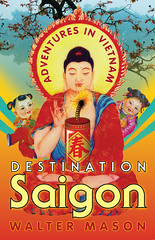
Destination Saigon, by Walter Mason is a funny, touching and truly unique journey through contemporary Vietnam.
Food Feature: Naengmyeon, Korean
-
Addicted to Korean BBQ, obsessed with Korean fried chicken? Can’t get
enough of bibimbap? Noodlies, reckon you shouldn’t forget about this Korean
noodle ...
A pile of books for the New Year!
-
A little squiz at what I plan on reading first thing this year.
From the top:
*Michelle de Kretser on Shirley Hazzard* - Anyone who knows me will know
t...

 Every time I return to Vietnam people in "The City" have added another floor to their houses, and long, steep and perilous stairways are very common in urban Saigon dwellings.
 I love buying all the Home Beautiful style magazines when I am there to see how the rich are building and decorating their often quite tiny homes.
 Each number indicates an alley you need to turn down, and heaven help you if you make a wrong turn - re-tracing your steps can take up a lot of time, and leave you emerging into streets and districts you've never seen before.
 Frequently, in order to get to an actual house, you have to tramp through the premises of a cafe, a pharmacy or a dressmaker.