Thursday, January 29, 2015

Walter Mason illustrated lecture on Graham Greene's Vietnam


I'll be at Ashfield Library on Saturday February 7, 2015 from 11am - 12pm in the Local Studies Room (just off the main library floor), Level 2, Civic Centre talking about Graham Greene, Vietnam and The Quiet American and I would love to see you there.

I have been obsessed with Greene's short and perfect novel about Vietnam ever since I first read it when I visited Vietnam at the age of 24.

My interest in The Quiet American, and Greene the writer, has only grown over the years.

I am delighted to be able to show you some of Greene's novel and where and how it is reflected in Vietnam in the 21st Century.

Do join me at this free talk illustrated with my own photos and reflections.

I can promise you an engaging and entertaining hour.

Thursday, October 23, 2014

Always in threes: the significance of 3 in Buddhism

"Different schools of Buddhism all have different devotional practices to the Buddha, although all  Buddhists make symbolic offerings to the Three Jewels, that is, the Buddha (teacher), Dharma (teachings), and Sangha (community)."

Andi Young "The Sacred Art of Bowing"


Recently I was teaching a course on Vietnamese history, and naturally enough Buddhism was a part of the discussion. While discussing a ritual, one of the students asked me: "Why is everything always done in threes in Buddhism?"
I realised then that I had a lot to explain, and I thought I would do so on this blog.


When one bows at a Buddhist shrine, one always makes three prostrations. At the same time one offers three sticks of incense. When you make a ceremonial procession around a temple or tomb you do so three times.

3 sticks of incense offered at a buddhist shrine in Binh Dinh, Vietnam


This number is not arbitrary. Buddhists instantly understand that the number 3 represents the Three Jewels (the Triratna) that make up Buddhism. These are:

Sakyamuni Buddha


1. The Buddha: The person of the historical Buddha Sakyamuni.

2. The Dharma: The body of teachings that describe Buddhist doctrine and belief.

3. The Sangha: The group of people who follow the Buddha and his teachings. This was traditionally interpreted as the ordained celibate clergy who serve the Buddha exclusively, but most modern Buddhists extend the meaning to incorporate the communities of lay-people who follow the Buddhist path.

And so each time we bow, and each time we place a a stick of incense in the burner, we are recalling one of these "Jewels," these essential elements of the Buddhism. 

Monday, April 28, 2014

Quan Am Pagoda, Phu Nhuan


One of the places I find myself constantly recommending people visit is the little-known Quan Am Pagoda in Phu Nhuan District, Ho Chi Minh City.


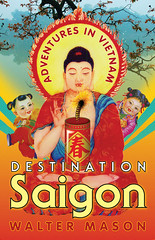
This temple is also mentioned in my book, Destination Saigon, and I have been visiting there for almost 15 years now.


It is a pretty basic suburban temple, but it was the Saigon residence of Thich Quang Duc, and as I mentioned in a previous post, it has become something of a shrine to him.
Downstairs is a large shrine to Thich Quang Duc Bodhisattva and the other Buddhist martyrs that followed him - most people don't realise that many people, both monastic and lay, followed his example and set fire to themselves in protest to the war.


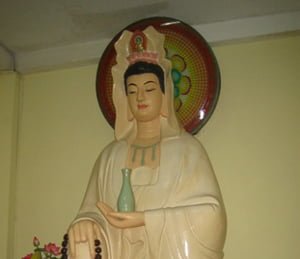
There is also a large and very kitsch grotto housing a quite unique shrine to Quan Am (Kwan Yin). This particular shrine is very popular with locals, and the statue of Quan Am is quite unique, in a form rarely seen.


To get to the grotto you need to walk through the gift shop to the left of the temple, and then climb up through the fake cave. Offerings are made from behind the statue. This grotto is exceedingly cramped, and should you meet someone on your way up or down one of you is going have to re-trace your steps - it is almost impossible to pass another person.

Details: Chua Quan Am - Phu Nhuan, 90 Thích Quảng Đức St, Phu Nhuan, Ho Chi Minh City

Monday, December 23, 2013

Vinh Nghiem Temple, Cabramatta

Vinh Nghiem Temple is one of the Buddhist temples most easily accessible via public transport in Cabramatta.


Now anyone who knows Vinh Nghiem Temple in Vietnam might feel a little let down by the distinctly more humble aspect of Sydney's branch.


Vinh Nghiem in Ho Chi Minh City is Vietnam's largest and most vibrant Buddhist institution, a constant on any tourist itinerary. In Sydney it is a humble fibro cottage with an add-on out the back.


But rest assured it is the real McCoy - the Abbot, Ven. Thich Vien Chon, hails from Vinh Nghiem TPHCM, and was in his day a famous teacher at the Vinh Nghiem Buddhist High School (now closed).
We had a lovely time making our own fresh spring rolls (goi cuon) under the tutelage of Vinh Nghiem Temple's resident nuns.


Details:

Vinh Nghiem Temple
177 John Street, CABRAMATTA, NSW 2166

Open every day - all welcome - enter through the carport on the left side of the house.

Thursday, November 28, 2013

Vietnam on the WWW - a roundup

Tonight I am joining a diverse bunch of writers at the NSW Writers' Centre to discuss Vietnam and writing about it. In preparation I thought I'd offer up some of the latest news from the web:


Painting by Vietnamese artist ViVi Vo Hung Kiet in Salt Lake City


Wednesday, March 27, 2013

Van Duc Temple, Thu Duc, Ho Chi Minh City - Places to Visit in Vietnam


If you are planning a holiday to Vietnam then you should definitely put aside a morning or afternoon while you are in Ho Chi Minh City in order to visit Thu Duc. Thu Duc is a fascinating place.
It is a vast geographic area, almost a city in itself, though it is classified as one of the districts of Ho Chi Minh City. It has always been something of a poor cousin, home to slums and sub-standard housing, though in recent years this seems to be changing, and Thu Duc's proximity to central Saigon (it's just across the river) is seeing it become increasingly prosperous.
One of the places I use as a gauge of that prosperity is Van Duc Temple.


I first visited the temple in the late 90s and it was a very humble affair indeed, despite being the home of the then most senior Buddhist master in Vietnam, The Most Venerable Thich Tri Tinh. It was dusty and a little ramshackle, having been originally constructed in 1954. The large and quite unique satue of Kwan Yin (Quan The Am, the Buddhist Bodhisattva of Mercy) was already in place, but she was installed on quite a shoddy and tacky little stand in the middle of a sad and muddy pond.
Van Duc has undergone quite a renovation.


The same statue is now housed in a solid and ornate construction, and the temple's main prayer hall is cavernous, with incredibly high ceilings and the capacity to seat hundreds of worshippers.


There is a large monastic community, and the surrounding area is home to many different Buddhist temples, as well as a Benedictine monastery of some note.


If you keep walking down the Tinh Lo 43 (the name of the road the temple is on) and turn down the first No. 7 Road (there are actually two No. 7 Roads, one after the other) you will see a collection of 7 or 8 tiny temples crammed onto a single country laneway. I have no idea why this is, but there is obviously some historic reason for it.

Details:

Van Duc Temple (Chua Van Duc)
502 Tinh Lo 43
Khu Pho 5
P. Tam Phu
Q. Thu Duc
Ho Chi Minh City

The temple is about a 20 minute taxi ride from downtown Saigon.
It might be best to get the taxi to wait for you while you explore, as there aren't many taxis in this area.


Monday, January 7, 2013

Monday Blogcrawl - Buddhism

Some Buddhist stuff from around the www this past week:


Stories of the Buddha in art


Related Posts with Thumbnails