When I was in Vietnam last time I made the acquaintance of a really
lovely (and impossibly handsome) young monk from Hanoi called Thay
Nguyen. He had come to Saigon to study at the
Buddhist University, and I would go to visit him in his suburban temple, hidden down an incredible maze of back streets and alleys. It was a busy
temple,
a real community hub, as such temples tend to be. In the afternoons we
would sit out on the monks' terrace garden and discuss some of the finer
points of
Buddhist philosophy, in a wonderfully effective mix of English and
Vietnamese.
He always had gifts for me - CDs of
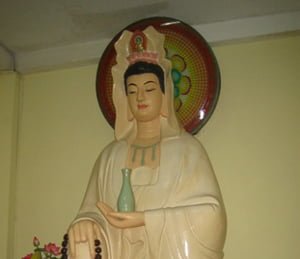
Kwan Yin chants,
colourful plastic prayer beads and, once, a book by the Dalai Lama in
Vietnamese. That was rather too ambitious a gift, I'm afraid.
One of the texts that Thay Nguyen enthusisatically endorsed was
Liao Fan's Four Lessons, a book which I had in fact read several times before.
In
recent days I have been listening to a very old series of cassettes on
which the book is read - something I picked up at a temple in Sydney 10
or more years ago - and I am struck by what a good guide to life it
really is.
It is a kind of Chinese self-help book, advocating that wholesome mix of
Buddhism,
Confucianism
and Taoism that has sustained the spiritual life of the Chinese for a
thousand years, and has in turn had such a great influence on
Vietnamese culture. It tells the story of a Mr. Liao Fan, a man who set great store by the predictions of
psychics and
soothsayers. After a chance meeting with a
Zen master,
he learnes that in fact destiny can change at any point, and that all
people should be involved in re-shaping their destiny for the better.
Then follows a long list of different
methods for acquiring good karma, all illustrated with stories from
Chinese mythology and antiquity.
In terms of
Vietnamese culture it is probably quite a salient text. The people living in
21st Century Vietnam still set great store on the teachings of
psychics, mediums and feng-shui masters, though all occupations are officially banned by the
Communist government.
Thay Nguyen was constantly coming up against parishioners who were
distraught because of some bad forecast for the future, or overly-casual
about spiritual cultivation because they were completely convinced that
their destiny was pre-ordained.
As a popular cultural text,
Liao Fan's Four Lessons is absolutely intriguing. Indeed, it is so much admired by people of all religious stripes that in
Hong Kong and Taiwan there are societies established specifically to distribute
the book and propagate its teachings.
The
Vietnamese translation is becoming more readily available too, though
the ones I saw in Vietnam were always donated by a Buddhist group in
Taiwan, or were printed for commercial sale and distribution.